PDF · English
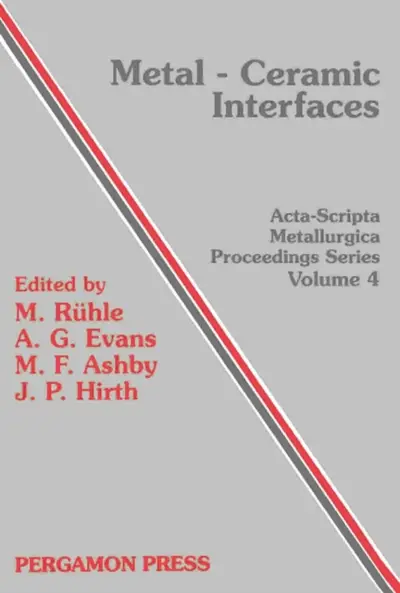
Metal-Ceramic Interfaces
Proceedings of an International Workshop
Price and availability
$59.99
Available in: Andorra, Austria, Australia, Belgium, Bulgaria, Canada, Switzerland, Cyprus, Czechia, Germany, Denmark, Estonia, Spain, Finland, France, United Kingdom, Guernsey, Greece, Croatia, Hungary, Ireland, Isle of Man, Iceland, Italy, Jersey, Japan, Liechtenstein, Lithuania, Luxembourg, Latvia, Monaco, Malta, Netherlands, Norway, Poland, Portugal, Romania, Sweden, Slovenia, Slovakia, San Marino, United States, Vatican City, South Africa
Stores: US, UK, Canada, EU, Australia.
Sign in to buyThe price is re-checked by the server before payment.
For personal use under the eBook licence.
- Format
- DRM
- Not stated by the publisher
- Language
- English
- Publisher
- Elsevier Science
- Published
- 22 October 2013
- ISBN
- 9781483287461
- Subjects
- Industrial chemistry, Materials science, Industrial chemistry and chemical engineering, Materials science
About this book
As engineering materials and structures often contain a metal or metallic alloy bonded to a ceramic, the resultant interface must be able to sustain mechanical forces without failure. They also play an important role in oxidation or reduction of materials. The workshop on 'Bonding, Structure and Mechanical Properties of Metal/Ceramic Interfaces' was held in January 1989 within the Acta/Scripta Metallurgica conference series. It drew together an international collection of 70 scientists who discussed a wide range of issues related to metal-ceramic interfaces. The sessions were divided into 7 categories: structure and bonding, chemistry at interfaces, formation of interfaces, structure of interfaces, thermodynamics/atomistics of interface fracture, mechanics of interface cracks, and fracture resistance of bimaterial interfaces. Within these headings attention was paid to grain boundaries, the influence of chemical processes on the behaviour of interfaces, diffusion bonding, characterization of fracture, and crack propagation by fatigue and by stress corrosion. The book presents a useful reference source for materials scientists, physicists, chemists, and mechanical engineers who are concerned with the roles and properties of interfaces.
Bibliographic data © Gardners Books Ltd.