PDF · English
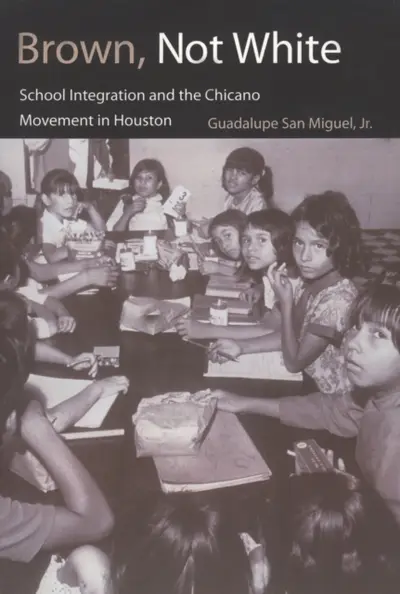
Brown, Not White
School Integration and the Chicano Movement in Houston
Price and availability
$18.99
Available in: Andorra, Austria, Australia, Belgium, Bulgaria, Canada, Switzerland, Cyprus, Czechia, Germany, Denmark, Estonia, Spain, Finland, France, United Kingdom, Guernsey, Greece, Croatia, Hungary, Ireland, Isle of Man, Iceland, Italy, Jersey, Japan, Liechtenstein, Lithuania, Luxembourg, Latvia, Monaco, Malta, Netherlands, Norway, Poland, Portugal, Romania, Sweden, Slovenia, Slovakia, San Marino, United States, Vatican City, South Africa
Stores: US, UK, Canada, EU, Australia.
Sign in to buyThe price is re-checked by the server before payment.
For personal use under the eBook licence.
- Format
- DRM
- Not stated by the publisher
- Language
- English
- Publisher
- Texas A&M University Press
- Published
- 26 October 2005
- ISBN
- 9781603446051
- Subjects
- Texas, Western & Pacific Coast states, c 1970 to c 1980, History of the Americas, Social & cultural history, Organization & management of education, 1KBB-US-SWT, 1KBB-US-W, 3MPQV, Educational administration and organization, NHK, NHTB
About this book
Strikes, boycotts, rallies, negotiations, and litigation marked the efforts of Mexican-origin community members to achieve educational opportunity and oppose discrimination in Houston schools in the early 1970s. These responses were sparked by the effort of the Houston Independent School District to circumvent a court order for desegregation by classifying Mexican American children as "e;white"e; and integrating them with African American childrenleaving Anglos in segregated schools. Gaining legal recognition for Mexican Americans as a minority group became the only means for fighting this kind of discrimination.The struggle for legal recognition not only reflected an upsurge in organizing within the community but also generated a shift in consciousness and identity. In Brown, Not White Guadalupe San Miguel, Jr., astutely traces the evolution of the community's political activism in education during the Chicano Movement era of the early 1970s.San Miguel also identifies the important implications of this struggle for Mexican Americans and for public education. First, he demonstrates, the political mobilization in Houston underscored the emergence of a new type of grassroots ethnic leadership committed to community empowerment and to inclusiveness of diverse ideological interests within the minority community. Second, it signaled a shift in the activist community's identity from the assimilationist "e;Mexican American Generation"e; to the rising Chicano Movement with its "e;nationalist"e; ideology. Finally, it introduced Mexican American interests into educational policy making in general and into the national desegregation struggles in particular.This important study will engage those interested in public school policy, as well as scholars of Mexican American history and the history of desegregation in America.
Bibliographic data © Gardners Books Ltd.