PDF · English
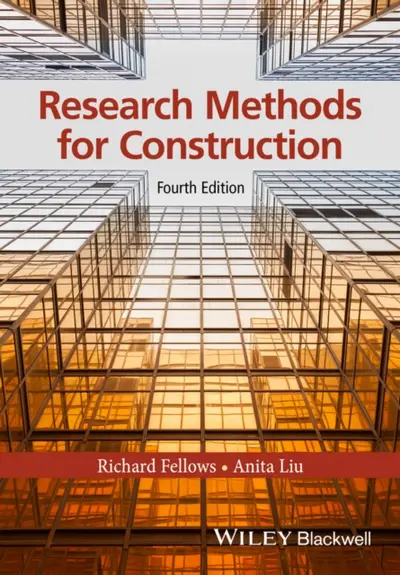
Research Methods for Construction
Price and availability
$45.99
Available in: Andorra, Austria, Australia, Belgium, Bulgaria, Canada, Switzerland, Cyprus, Czechia, Germany, Denmark, Estonia, Spain, Finland, France, United Kingdom, Guernsey, Greece, Croatia, Hungary, Ireland, Isle of Man, Iceland, Italy, Jersey, Japan, Liechtenstein, Lithuania, Luxembourg, Latvia, Monaco, Malta, Netherlands, Norway, Poland, Portugal, Romania, Sweden, Slovenia, Slovakia, San Marino, United States, Vatican City, South Africa
Stores: US, UK, Canada, EU, Australia.
Sign in to buyThe price is re-checked by the server before payment.
For personal use under the eBook licence.
- Format
- DRM
- Not stated by the publisher
- Language
- English
- Publisher
- Wiley
- Published
- 7 May 2015
- ISBN
- 9781118915721
- Subjects
- Civil engineering, surveying & building, Structural engineering, Civil engineering, surveying and building, Structural engineering
About this book
Research Methods for Construction will help you instil rigour into your problem-solving, and into your reports and publications. It will be of value to construction, surveying, architecture and civil engineering students undertaking research, whether for bachelors and masters degree dissertations, or for masters and doctoral research degree theses. Now in its Fourth Edition, this remains one of the few books to provide guidance on research formulation, methodologies, and methods specifically for construction students. Three main sections Producing a Proposal, Executing the Research and Reporting the Results discuss the key issues in research and examine the primary approaches, both qualitative and quantitative. The methods adopted for scientific and engineering experiments, model building and simulations are discussed, as well as those employed for research into management, social and economic issues. The authors examine the requirements for data and analysis, including the important statistical considerations and a range of qualitative techniques that enable construction researchers to appreciate what needs to be evaluated in devising how research may be carried out effectively and efficiently. This new edition has been updated to reflect current debates and concerns, including ethical issues, legislation and codes of practice concerning the collection, processing, storage, use and disposal of data. Pressures of time and funding to carry out the empirical work all too often lead to a lack of attention to how the study should be done and why. The authors address the importance of explaining the philosophical approach adopted (ontology, epistemology) and the consequent methodology. They advocate close scrutiny of the methods available for appropriateness, both academically and practically. The fundamental theme of the book remains to facilitate a researcher s informed and justified selection of a philosophical paradigm and of appropriate methods to execute the research.
Bibliographic data © Gardners Books Ltd.