PDF · English
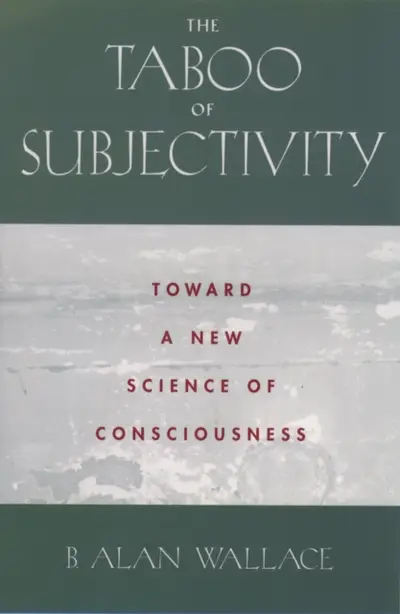
Taboo of Subjectivity
Toward a New Science of Consciousness
Price and availability
$41.99
Available in: Andorra, Austria, Australia, Belgium, Bulgaria, Canada, Switzerland, Cyprus, Czechia, Germany, Denmark, Estonia, Spain, Finland, France, United Kingdom, Guernsey, Greece, Croatia, Hungary, Ireland, Isle of Man, Iceland, Italy, Jersey, Japan, Liechtenstein, Lithuania, Luxembourg, Latvia, Monaco, Malta, Netherlands, Norway, Poland, Portugal, Romania, Sweden, Slovenia, Slovakia, San Marino, United States, Vatican City, South Africa
Stores: US, UK, Canada, EU, Australia.
Sign in to buyThe price is re-checked by the server before payment.
For personal use under the eBook licence.
- Format
- DRM
- Not stated by the publisher
- Language
- English
- Publisher
- Oxford University Press
- Published
- 12 February 2004
- ISBN
- 9780198038603
- Subjects
- Religion & science, History of science, History of science, QRAM3
About this book
This book takes a bold new look at ways of exploring the nature, origins, and potentials of consciousness within the context of science and religion. Alan Wallace draws careful distinctions between four elements of the scientific tradition: science itself, scientific realism, scientific materialism, and scientism. Arguing that the metaphysical doctrine of scientific materialism has taken on the role of ersatz-religion for its adherents, he traces its development from its Greek and Judeo-Christian origins, focusing on the interrelation between the Protestant Reformation and the Scientific Revolution. He looks at scientists' long term resistance to the firsthand study of consciousness and details the ways in which subjectivity has been deemed taboo within the scientific community. In conclusion, Wallace draws on William James's idea for a "e;science of religion"e; that would study the nature of religious and, in particular, contemplative experience. In exploring the nature of consciousness, this groundbreaking study will help to bridge the chasm between religious belief and scientific knowledge. It is essential reading for philosophers and historians of science, scholars of religion, and anyone interested in the relationship between science and religion.
Bibliographic data © Gardners Books Ltd.