PDF · English
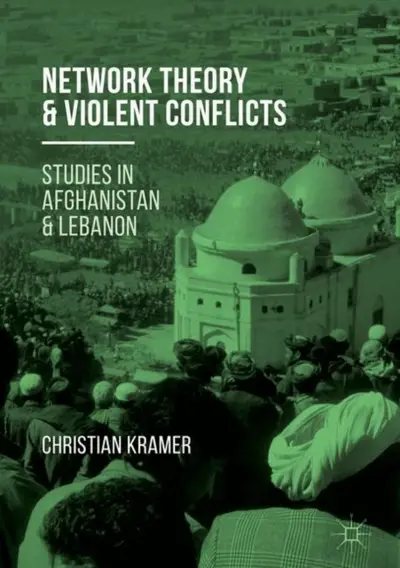
Network Theory and Violent Conflicts
Studies in Afghanistan and Lebanon
Price and availability
$148.99
Available in: Andorra, Austria, Australia, Belgium, Bulgaria, Canada, Switzerland, Cyprus, Czechia, Germany, Denmark, Estonia, Spain, Finland, France, United Kingdom, Guernsey, Greece, Croatia, Hungary, Ireland, Isle of Man, Iceland, Italy, Jersey, Japan, Liechtenstein, Lithuania, Luxembourg, Latvia, Monaco, Malta, Netherlands, Norway, Poland, Portugal, Romania, Sweden, Slovenia, Slovakia, San Marino, United States, Vatican City, South Africa
Stores: US, UK, Canada, EU, Australia.
Sign in to buyThe price is re-checked by the server before payment.
For personal use under the eBook licence.
- Format
- DRM
- Not stated by the publisher
- Language
- English
- Publisher
- Springer International Publishing
- Published
- 30 November 2016
- ISBN
- 9783319413938
- Subjects
- Lebanon, Afghanistan, Peace studies & conflict resolution, Armed conflict, Middle East, Peace studies and conflict resolution, Sociology, Politics and government, Political science and theory
About this book
This book offers a novel approach to understanding violence and violent conflict using complexity and network theories, borrowed from the natural sciences, together with social network analysis. Because violence is both a universal and central component of human communication and identity formation, it has a fundamental function in shaping social behavior. Using Manuel Castells' work on the programming of social networks, this book explores the Lebanese Civil War and the ongoing war in Afghanistan under the perspective of violence within networks. The approach presents a unique and compelling argument that counters the long-held assumption that war is caused by specific events, or is the unavoidable culmination of existing conditions or grievances. Rather, this book argues that violence emerges when the structure of social networks becomes too rigid and hierarchic to adapt to stresses and challenges that materialize on a constant basis from both within and without the network. This is important not only for the study of war, but as a method of improving the success of contemporary peace building efforts.
Bibliographic data © Gardners Books Ltd.