EPUB · English
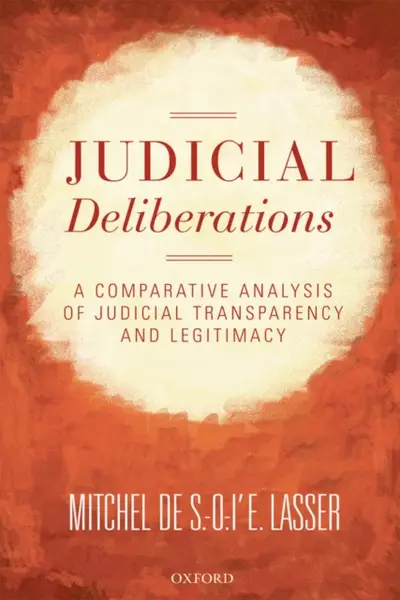
Judicial Deliberations
A Comparative Analysis of Transparency and Legitimacy
Price and availability
$45.99
Available in: Andorra, Austria, Australia, Belgium, Bulgaria, Canada, Switzerland, Cyprus, Czechia, Germany, Denmark, Estonia, Spain, Finland, France, United Kingdom, Guernsey, Greece, Croatia, Hungary, Ireland, Isle of Man, Iceland, Italy, Jersey, Japan, Liechtenstein, Lithuania, Luxembourg, Latvia, Monaco, Malta, Netherlands, Norway, Poland, Portugal, Romania, Sweden, Slovenia, Slovakia, San Marino, United States, Vatican City, South Africa
Stores: US, UK, Canada, EU, Australia.
Sign in to buyThe price is re-checked by the server before payment.
For personal use under the eBook licence.
- Format
- EPUB
- DRM
- Not stated by the publisher
- Language
- English
- Publisher
- Oxford University Press
- Published
- 21 October 2004
- ISBN
- 9780191018848
- Subjects
- EU (European Union), Jurisprudence & philosophy of law, Comparative law, Courts & procedure, Constitutional & administrative law, EU (European Union), Methods, theory and philosophy of law, Comparative law, Legal systems: courts and procedures, Constitutional and administrative law: general
About this book
Judicial Deliberations compares how and why the European Court of Justice, the French Cour de cassation and the US Supreme Court offer different approaches for generating judicial accountability and control, judicial debate and deliberation, and ultimately judicial legitimacy. Examining the judicial argumentation of the United States Supreme Court and of the French Cour de cassation, the book first reorders the traditional comparative understanding of the difference between French civil law and American common law judicial decision-making. It then uses this analysis to offer the first detailed comparative examination of the interpretive practice of the European Court of Justice. Lasser demonstrates that the French judicial system rests on a particularly unified institutional and ideological framework founded on explicitly republican notions of meritocracy and managerial expertise. Law-making per se may be limited to the legislature; but significant judicial normative administration is entrusted to State selected, trained, and sanctioned elites who are policed internally through hierarchical institutional structures. The American judicial system, by contrast, deploys a more participatory and democratic approach that reflects a more populist vision. Shunning the unifying, controlling, and hierarchical French structures, the American judicial system instead generates its legitimacy primarily by argumentative means. American judges engage in extensive debates that subject them to public scrutiny and control. The ECJ hovers delicately between the institutional/argumentative and republican/democratic extremes. On the one hand, the ECJ reproduces the hierarchical French discursive structure on which it was originally patterned. On the other, it transposes this structure into a transnational context of fractured political and legal assumptions. This drives the ECJ towards generating legitimacy by adopting a somewhat more transparent argumentative approach.
Bibliographic data © Gardners Books Ltd.