PDF · English
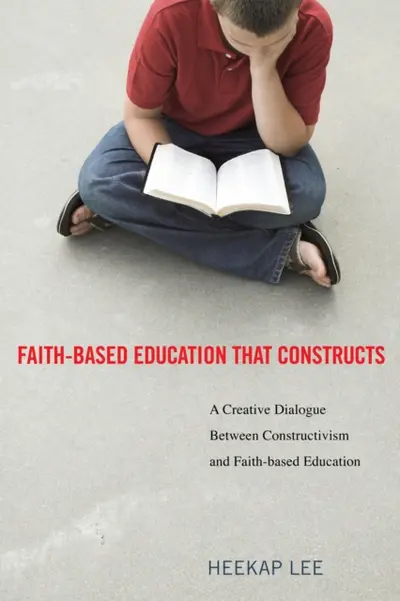
Faith-Based Education That Constructs
A Creative Dialogue between Contructivism and Faith-Based Education
Price and availability
$51.99
Available in: Andorra, Austria, Australia, Belgium, Bulgaria, Canada, Switzerland, Cyprus, Czechia, Germany, Denmark, Estonia, Spain, Finland, France, United Kingdom, Guernsey, Greece, Croatia, Hungary, Ireland, Isle of Man, Iceland, Italy, Jersey, Japan, Liechtenstein, Lithuania, Luxembourg, Latvia, Monaco, Malta, Netherlands, Norway, Poland, Portugal, Romania, Sweden, Slovenia, Slovakia, San Marino, United States, Vatican City, South Africa
Stores: US, UK, Canada, EU, Australia.
Sign in to buyThe price is re-checked by the server before payment.
For personal use under the eBook licence.
- Format
- DRM
- Not stated by the publisher
- Language
- English
- Publisher
- Wipf and Stock Publishers
- Published
- 9 August 2010
- ISBN
- 9781498271714
- Subjects
- Christianity, Christian institutions & organizations, Christian ministry & pastoral activity, Christianity, Religious ministry and clergy
About this book
Constructivism is everywhere. It is a hot issue at this time in the field of philosophy, education, technology, and religion. However, can constructivism be an alternative approach in faith-based education? While some conclude that Jesus knew learning was an active knowledge-creating process, and that he always encouraged his disciples to think deeply and go beyond the surface level, others would find that constructivism undercuts faith-based education because of its claims to relativity. For example, constructivists claim that meaning is imposed on the world by us rather than existing in the world independently from us. Thus, they proclaim that truth is relative to particular times, places, and people. Christians hold that truth does exist absolutely. So how can there be a way forward for faith-based educators who see the good in the constructivist approach? In Faith-Based Education that Constructs readers will find a unique approach whereby constructivism may appropriately be applied to a faith-based education setting. Although disagreement can occur between constructivism and faith-based education, this book concludes that constructivist thought and Christian faith-based education are, in the end, congruent and harmonious in significant ways. Those faith-based educators who continue to hold cautionary views of radical constructivist assertions against absolute truths need not disregard all other aspects of constructivism.
Bibliographic data © Gardners Books Ltd.