PDF · English
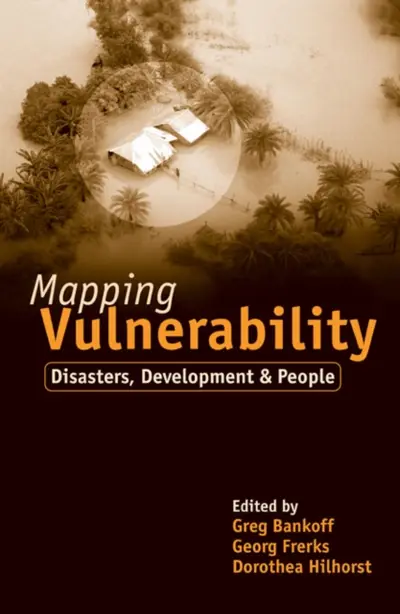
Mapping Vulnerability
Disasters, Development and People
Price and availability
$72.99
Available in: Andorra, Austria, Australia, Belgium, Bulgaria, Canada, Switzerland, Cyprus, Czechia, Germany, Denmark, Estonia, Spain, Finland, France, United Kingdom, Guernsey, Greece, Croatia, Hungary, Ireland, Isle of Man, Iceland, Italy, Jersey, Japan, Liechtenstein, Lithuania, Luxembourg, Latvia, Monaco, Malta, Netherlands, Norway, Poland, Portugal, Romania, Sweden, Slovenia, Slovakia, San Marino, United States, Vatican City, South Africa
Stores: US, UK, Canada, EU, Australia.
Sign in to buyThe price is re-checked by the server before payment.
For personal use under the eBook licence.
- Format
- DRM
- Not stated by the publisher
- Language
- English
- Publisher
- Taylor & Francis
- Published
- 17 June 2013
- ISBN
- 9781136561627
- Subjects
- Development studies, Social impact of disasters, Central government policies, Human geography, Natural disasters, Social impact of environmental issues, Asia, Africa, Latin America – Mexico, Central America, South America, Development studies, Social impact of disasters / accidents (natural or man-made), Natural disasters
About this book
Raging floods, massive storms and cataclysmic earthquakes: every year up to 340 million people are affected by these and other disasters, which cause loss of life and damage to personal property, agriculture, and infrastructure. So what can be done? The key to understanding the causes of disasters and mitigating their impacts is the concept of 'vulnerability'. Mapping Vulnerability analyses 'vulnerability' as a concept central to the way we understand disasters and their magnitude and impact. Written and edited by a distinguished group of disaster scholars and practitioners, this book is a counterbalance to those technocratic approaches that limit themselves to simply looking at disasters as natural phenomena. Through the notion of vulnerability, the authors stress the importance of social processes and human-environmental interactions as causal agents in the making of disasters. They critically examine what renders communities unsafe - a condition, they argue, that depends primarily on the relative position of advantage or disadvantage that a particular group occupies within a society's social order. The book also looks at vulnerability in terms of its relationship to development and its impact on policy and people's lives, through consideration of selected case studies drawn from Africa, Asia and Latin America. Mapping Vulnerability is essential reading for academics, students, policymakers and practitioners in disaster studies, geography, development studies, economics, environmental studies and sociology.
Bibliographic data © Gardners Books Ltd.