PDF · English
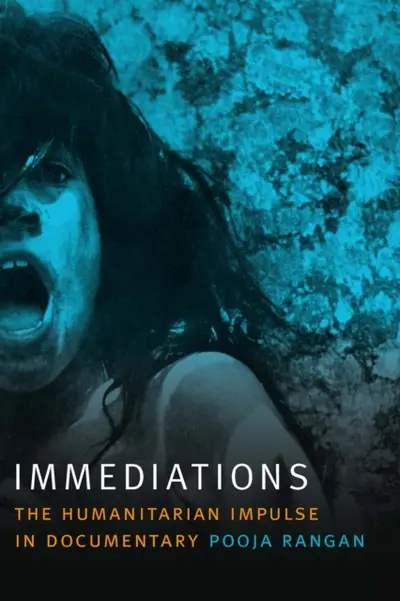
Immediations
The Humanitarian Impulse in Documentary
Price and availability
$47.99
Available in: Andorra, Austria, Australia, Belgium, Bulgaria, Canada, Switzerland, Cyprus, Czechia, Germany, Denmark, Estonia, Spain, Finland, France, United Kingdom, Guernsey, Greece, Croatia, Hungary, Ireland, Isle of Man, Iceland, Italy, Jersey, Japan, Liechtenstein, Lithuania, Luxembourg, Latvia, Monaco, Malta, Netherlands, Norway, Poland, Portugal, Romania, Sweden, Slovenia, Slovakia, San Marino, United States, Vatican City, South Africa
Stores: US, UK, Canada, EU, Australia.
Sign in to buyThe price is re-checked by the server before payment.
For personal use under the eBook licence.
- Format
- DRM
- Not stated by the publisher
- Language
- English
- Publisher
- Duke University Press
- Published
- 18 May 2017
- ISBN
- 9780822373100
- Subjects
- Film theory & criticism, Documentary films, ATFA, ATFR
About this book
Endangered life is often used to justify humanitarian media intervention, but what if suffering humanity is both the fuel and outcome of such media representations? Pooja Rangan argues that this vicious circle is the result of immediation, a prevailing documentary ethos that seeks to render human suffering urgent and immediate at all costs. Rangan interrogates this ethos in films seeking to "e;give a voice to the voiceless,"e; an established method of validating the humanity of marginalized subjects, including children, refugees, autistics, and animals. She focuses on multiple examples of documentary subjects being invited to demonstrate their humanity: photography workshops for the children of sex workers in Calcutta; live eyewitness reporting by Hurricane Katrina survivors; attempts to facilitate speech in nonverbal autistics; and painting lessons for elephants. These subjects are obliged to represent themselves using immediations-tropes that reinforce their status as the "e;other"e; and reproduce definitions of the human that exclude non-normative modes of thinking, being, and doing. To counter these effects, Rangan calls for an approach to media that aims not to humanize but to realize the full, radical potential of giving the camera to the other.
Bibliographic data © Gardners Books Ltd.