PDF · English
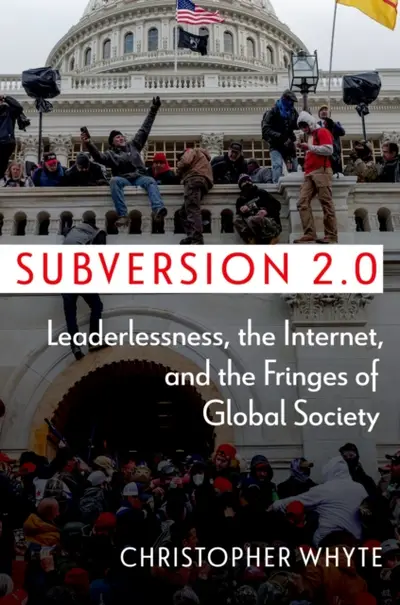
Subversion 2.0
Leaderlessness, the Internet, and the Fringes of Global Society
Price and availability
$21.99
Available in: Andorra, Austria, Australia, Belgium, Bulgaria, Canada, Switzerland, Cyprus, Czechia, Germany, Denmark, Estonia, Spain, Finland, France, United Kingdom, Guernsey, Greece, Croatia, Hungary, Ireland, Isle of Man, Iceland, Italy, Jersey, Japan, Liechtenstein, Lithuania, Luxembourg, Latvia, Monaco, Malta, Netherlands, Norway, Poland, Portugal, Romania, Sweden, Slovenia, Slovakia, San Marino, United States, Vatican City, South Africa
Stores: US, UK, Canada, EU, Australia.
Sign in to buyThe price is re-checked by the server before payment.
For personal use under the eBook licence.
- Format
- DRM
- Not stated by the publisher
- Language
- English
- Publisher
- Oxford University Press
- Published
- 24 July 2024
- ISBN
- 9780197773376
- Subjects
- Social issues & processes, Diplomacy, Espionage & secret services, JBF, Diplomacy, Espionage and secret services
About this book
Why are conspiracy theories, extremist rhetoric, and acts of antagonism by fringe elements of society so much more visible today than in years past? The Capitol Insurrection of January 6, 2021, and the surge of medical skepticism during the global COVID-19 pandemic have highlighted the challenge of extreme rhetoric in global society, with increasing attention paid to the enabling role of the Internet. But beyond the ways in which the Internet allows for connection, how do fringe ideas travel into the mainstream to become more significant movements?In Subversion 2.0, Christopher Whyte describes the transformation of societal subversion in the digital age. Whyte makes the case that "e;leaderlessness"e;--characterized by an evolving and uneven feedback loop linking fringe spaces to mainstream elite rhetoric and popular discourse--has emerged in recent years as the default format of subversive activity. Through case explorations and novel data, Whyte shows how extreme narratives that originate in conspiratorial, restrictive virtual spaces are rapidly filtered into mainstream settings due to a series of socio-technological conditions present in the Web 2.0 era. As a result, fringe narratives and symbols often become the lens through which social and political elites interpret information that they then spread through public speech, which is projected back to subversive spaces and used to perpetuate fringe narratives. By examining the uneven feedback loop of leaderlessness, Whyte argues that social Internet platforms act as a vehicle for transmitting and amplifying extreme rhetoric but often fail to moderate extremism in turn. He ultimately shows how societal subversion, an activity that is about degrading existing power structures without directly attacking them, has taken on a new, dynamic form in the digital age.
Bibliographic data © Gardners Books Ltd.