PDF · English
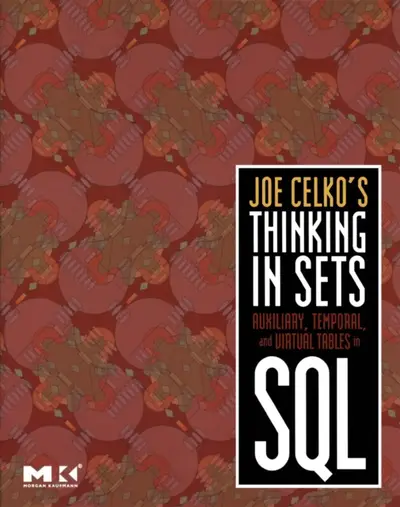
Joe Celko's Thinking in Sets: Auxiliary, Temporal, and Virtual Tables in SQL
Price and availability
$27.99
Available in: Andorra, Austria, Australia, Belgium, Bulgaria, Canada, Switzerland, Cyprus, Czechia, Germany, Denmark, Estonia, Spain, Finland, France, United Kingdom, Guernsey, Greece, Croatia, Hungary, Ireland, Isle of Man, Iceland, Italy, Jersey, Japan, Liechtenstein, Lithuania, Luxembourg, Latvia, Monaco, Malta, Netherlands, Norway, Poland, Portugal, Romania, Sweden, Slovenia, Slovakia, San Marino, United States, Vatican City, South Africa
Stores: US, UK, Canada, EU, Australia.
Sign in to buyThe price is re-checked by the server before payment.
For personal use under the eBook licence.
- Format
- DRM
- Not stated by the publisher
- Language
- English
- Publisher
- Elsevier Science
- Published
- 22 January 2008
- ISBN
- 9780080557526
- Subjects
- Programming & scripting languages: general, Programming and scripting languages: general
About this book
Perfectly intelligent programmers often struggle when forced to work with SQL. Why? Joe Celko believes the problem lies with their procedural programming mindset, which keeps them from taking full advantage of the power of declarative languages. The result is overly complex and inefficient code, not to mention lost productivity.This book will change the way you think about the problems you solve with SQL programs.. Focusing on three key table-based techniques, Celko reveals their power through detailed examples and clear explanations. As you master these techniques, you'll find you are able to conceptualize problems as rooted in sets and solvable through declarative programming. Before long, you'll be coding more quickly, writing more efficient code, and applying the full power of SQL- Filled with the insights of one of the world's leading SQL authorities - noted for his knowledge and his ability to teach what he knows- Focuses on auxiliary tables (for computing functions and other values by joins), temporal tables (for temporal queries, historical data, and audit information), and virtual tables (for improved performance)- Presents clear guidance for selecting and correctly applying the right table technique
Bibliographic data © Gardners Books Ltd.