PDF · English
New Poetic
Yeats to Eliot
Price and availability
Not sold in this region
Available in: Andorra, Austria, Australia, Belgium, Bulgaria, Switzerland, Cyprus, Czechia, Germany, Denmark, Estonia, Spain, Finland, France, United Kingdom, Guernsey, Greece, Croatia, Hungary, Ireland, Isle of Man, Iceland, Italy, Jersey, Japan, Liechtenstein, Lithuania, Luxembourg, Latvia, Monaco, Malta, Netherlands, Norway, Poland, Portugal, Romania, Sweden, Slovenia, Slovakia, San Marino, Vatican City, South Africa
Stores: UK, EU, Australia. Not available in the United States store.
This title cannot be bought in this store yet: its supplier terms, territorial rights or price are still being confirmed.
For personal use under the eBook licence.
- Format
- DRM
- Not stated by the publisher
- Language
- English
- Publisher
- Bloomsbury Publishing
- Published
- 15 March 2007
- Pages
- 192
- ISBN
- 9781441189875
- Subjects
- United Kingdom, Great Britain, English, Literary studies: c 1800 to c 1900, Literary studies: from c 1900 -, Literary studies: poetry & poets, 2ACB, Literary studies: c 1800 to c 1900, Literary studies: c 1900 to c 2000, Literary studies: poetry and poets
About this book
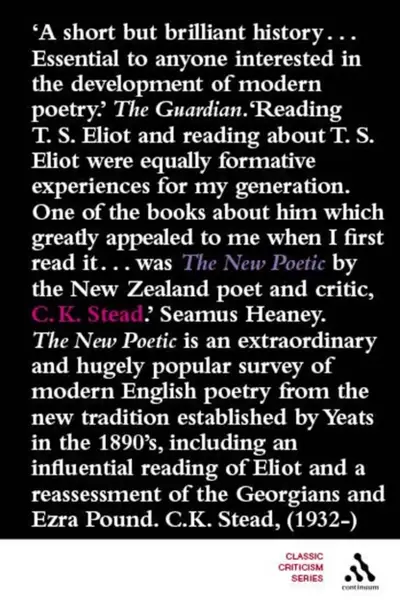
A classic survey of modern English poetry from the new tradition established by Yeats in the 1890s through to Eliot, including a reassessment of the Georgians and the influence of Pound.'A short but brilliant history. Essential to anyone interested in the development of modern poetry.' The Guardian'Reading T. S. Eliot and reading about T. S. Eliot were equally formative experiences for my generation. One of the books about him which greatly appealed to me when I first read it ... was The New Poetic by the New Zealand poet and critic, C. K. Stead...'The Waste Land in Stead's reading is the vindication of a poetry of image, texture and suggestiveness; of inspiration; of poetry which writes itself. It represents a defeat of the will, an emergence of the ungainsayable and symbolically radiant out of the subconscious deeps. Rational structure has been overtaken or gone through like the sound barrier. The poem does not disdain intellect, yet poetry, having to do with feelings and emotions, must not submit to the intellect's eagerness to foreclose. It must wait for a music to occur, an image to discover itself. Stead thus rehabilitated Eliot as a Romantic poet, every bit as faithful to the process of dream and susceptible to gifts of the unconscious as Coleridge was before he received the person from Porlock. And so the figure of Old Possum, netted for years in skeins of finely-drawn commentary upon his sources, his ideas, his criticism of the modern world and so on, this figure was helped to rise again like Gulliver in Lilliput, no longer a hazy contour of philosophy and literary allusion, but a living principle, a far more natural force than had been recognized until then.' - Seamus Heaney, The Government of the Tongue (1986)
Bibliographic data © Gardners Books Ltd.