PDF · English
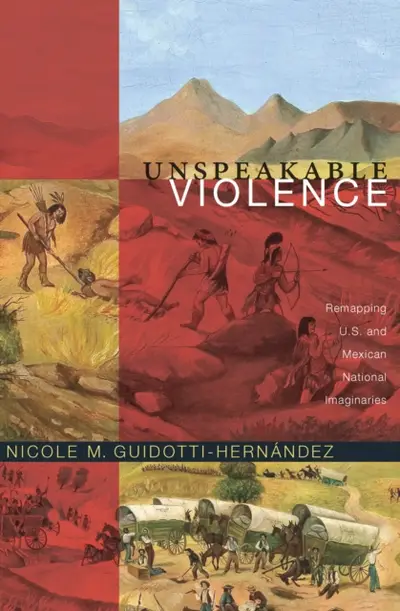
Unspeakable Violence
Remapping U.S. and Mexican National Imaginaries
Price and availability
$54.99
Available in: Andorra, Austria, Australia, Belgium, Bulgaria, Canada, Switzerland, Cyprus, Czechia, Germany, Denmark, Estonia, Spain, Finland, France, United Kingdom, Guernsey, Greece, Croatia, Hungary, Ireland, Isle of Man, Iceland, Italy, Jersey, Japan, Liechtenstein, Lithuania, Luxembourg, Latvia, Monaco, Malta, Netherlands, Norway, Poland, Portugal, Romania, Sweden, Slovenia, Slovakia, San Marino, United States, Vatican City, South Africa
Stores: US, UK, Canada, EU, Australia.
Sign in to buyThe price is re-checked by the server before payment.
For personal use under the eBook licence.
- Format
- DRM
- Not stated by the publisher
- Language
- English
- Publisher
- Duke University Press
- Published
- 10 October 2011
- ISBN
- 9780822394495
- Subjects
- USA, Mexico, c 1800 to c 1900, 20th century, Literary studies: general, History of the Americas, Modern history to 20th century: c 1700 to c 1900, 20th century history: c 1900 to c 2000, Social & cultural history, Gender studies: women, Hispanic & Latino studies, United States of America, USA, Mexico, 3MN, 3MP, Literary studies: general, JBSF1, JBSL, NH, NHK, NHTB
About this book
Unspeakable Violence addresses the epistemic and physical violence inflicted on racialized and gendered subjects in the U.S.-Mexico borderlands from the mid-nineteenth century through the early twentieth. Arguing that this violence was fundamental to U.S., Mexican, and Chicana/o nationalisms, Nicole M. Guidotti-Hernandez examines the lynching of a Mexican woman in California in 1851, the Camp Grant Indian Massacre of 1871, the racism evident in the work of the anthropologist Jovita Gonzalez, and the attempted genocide, between 1876 and 1907, of the Yaqui Indians in the Arizona-Sonora borderlands. Guidotti-Hernandez shows that these events have been told and retold in ways that have produced particular versions of nationhood and effaced other issues. Scrutinizing stories of victimization and resistance, and celebratory narratives of mestizaje and hybridity in Chicana/o, Latina/o, and borderlands studies, she contends that by not acknowledging the racialized violence perpetrated by Mexicans, Chicanas/os, and indigenous peoples, as well as Anglos, narratives of mestizaje and resistance inadvertently privilege certain brown bodies over others. Unspeakable Violence calls for a new, transnational feminist approach to violence, gender, sexuality, race, and citizenship in the borderlands.
Bibliographic data © Gardners Books Ltd.