EPUB · English
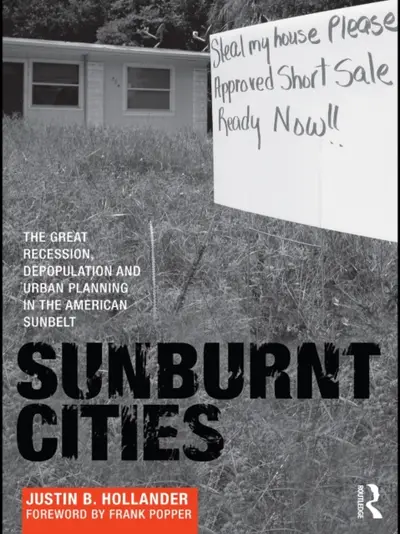
Sunburnt Cities
The Great Recession, Depopulation and Urban Planning in the American Sunbelt
Price and availability
$75.99
Available in: Andorra, Austria, Australia, Belgium, Bulgaria, Canada, Switzerland, Cyprus, Czechia, Germany, Denmark, Estonia, Spain, Finland, France, United Kingdom, Guernsey, Greece, Croatia, Hungary, Ireland, Isle of Man, Iceland, Italy, Jersey, Japan, Liechtenstein, Lithuania, Luxembourg, Latvia, Monaco, Malta, Netherlands, Norway, Poland, Portugal, Romania, Sweden, Slovenia, Slovakia, San Marino, United States, Vatican City, South Africa
Stores: US, UK, Canada, EU, Australia.
Sign in to buyThe price is re-checked by the server before payment.
For personal use under the eBook licence.
- Format
- EPUB
- DRM
- Not stated by the publisher
- Language
- English
- Publisher
- Taylor & Francis
- Published
- 18 January 2011
- ISBN
- 9781136849084
- Subjects
- City & town planning - architectural aspects, Urban communities, United States of America, USA, Population and migration geography, Settlement, urban and rural geography, Urban and municipal planning and policy
About this book
In recent years there has been a growing focus on urban and environmental studies, and the skills and techniques needed to address the wider challenges of how to create sustainable communities. Central to that demand is the increasing urgency of addressing the issue of urban decline, and the response has almost always been to pursue growth policies to attempt to reverse that decline. The track record of growth policies has been mixed at best. Until the first decade of the twenty-first century decline was assumed to be an issue only for former industrial cities - the so-called Rust Belt. But the sudden reversal in growth in the major cities of the American Sunbelt has shown that urban decline can be a much wider issue. Justin Hollander's research into urban decline in both the Sun and Rust Belts draws lessons planners and policy makers that can be applied universally. Hollander addresses the reasons and statistics behind these "e;shrinking cities"e; with a positive outlook, arguing that growth for growth's sake is not beneficial for communities, suggesting instead that urban development could be achieved through shrinkage. Case studies on Phoenix, Flint, Orlando and Fresno support the argument, and Hollander delves into the numbers, literature and individual lives affected and how they have changed in response to the declining regions. Written for urban scholars and to suit a wide range of courses focused on contemporary urban studies, this text forms a base for all study on shrinking cities for professionals, academics and students in urban design, planning, public administration and sociology.
Bibliographic data © Gardners Books Ltd.