EPUB · English
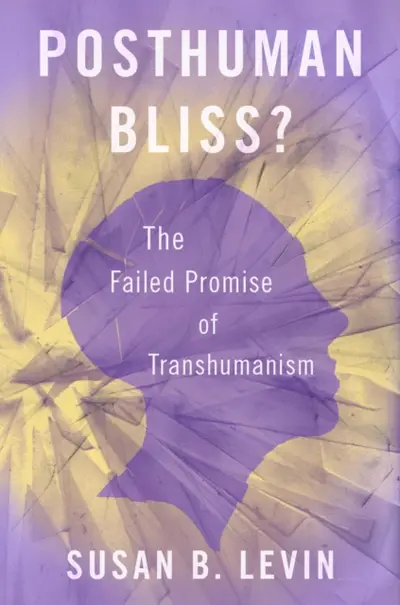
Posthuman Bliss?
The Failed Promise of Transhumanism
Price and availability
$62.99
Available in: Andorra, Austria, Australia, Belgium, Bulgaria, Canada, Switzerland, Cyprus, Czechia, Germany, Denmark, Estonia, Spain, Finland, France, United Kingdom, Guernsey, Greece, Croatia, Hungary, Ireland, Isle of Man, Iceland, Italy, Jersey, Japan, Liechtenstein, Lithuania, Luxembourg, Latvia, Monaco, Malta, Netherlands, Norway, Poland, Portugal, Romania, Sweden, Slovenia, Slovakia, San Marino, United States, Vatican City, South Africa
Stores: US, UK, Canada, EU, Australia.
Sign in to buyThe price is re-checked by the server before payment.
For personal use under the eBook licence.
- Format
- EPUB
- DRM
- Not stated by the publisher
- Language
- English
- Publisher
- Oxford University Press
- Published
- 3 December 2020
- ISBN
- 9780190051518
- Subjects
- Philosophy of mind, Ethics & moral philosophy, Social & political philosophy, Bio-ethics, Bioethics, QDTM, QDTQ, QDTS
About this book
A tightly argued and expansive examination of the pitfalls of transhumanism that reacquaints us with what it means to live well. Advocates of transhumanism, or "e;radical"e; enhancement, urge us to pursue the biotechnological heightening of select capacities -- above all, cognitive ability -- so far beyond any human limit that the beings with those capacities would exist on a higher ontological plane. For proponents of such views, humanity's self-transcendence through advancements in science and technology may even be morally required. Consequently, the human stakes of how we respond to transhumanism are immeasurably high. In Posthuman Bliss? The Failed Promise of Transhumanism, Susan B. Levin challenges transhumanists' overarching commitments regarding the mind and brain, ethics, liberal democracy, knowledge, and reality, showing their notion of humanity's self-transcendence into "e;posthumanity"e; to be little more than fantasy. Uniting philosophical with scientific arguments, Levin mounts a significant challenge to transhumanists' claim that science and technology support their vision of posthumanity. In a clear and engaging style, she dismantles transhumanists' breezy assurances that posthumans will emerge if we but allocate sufficient resources to that end. Far from offering theoretical and practical "e;proof of concept"e; for the vision that they urge upon us, Levin argues, transhumanists engage inadequately with cognitive psychology, biology, and neuroscience, often relying on questionable or outdated views within those fields. Having shown in depth why transhumanism should be rejected, Levin argues forcefully for a holistic perspective on living well that is rooted in Aristotle's virtue ethics but that is adapted to liberal democracy. This holism is thoroughly human, in the best of senses: It directs us to consider worthy ends for us as human beings and to do the irreplaceable work of understanding ourselves rather than relying on technology and science to be our salvation.
Bibliographic data © Gardners Books Ltd.