EPUB · English
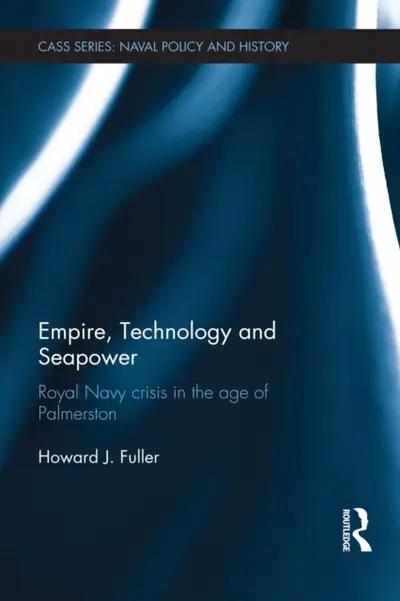
Empire, Technology and Seapower
Royal Navy crisis in the age of Palmerston
Price and availability
$58.99
Available in: Andorra, Austria, Australia, Belgium, Bulgaria, Canada, Switzerland, Cyprus, Czechia, Germany, Denmark, Estonia, Spain, Finland, France, United Kingdom, Guernsey, Greece, Croatia, Hungary, Ireland, Isle of Man, Iceland, Italy, Jersey, Japan, Liechtenstein, Lithuania, Luxembourg, Latvia, Monaco, Malta, Netherlands, Norway, Poland, Portugal, Romania, Sweden, Slovenia, Slovakia, San Marino, United States, Vatican City, South Africa
Stores: US, UK, Canada, EU, Australia.
Sign in to buyThe price is re-checked by the server before payment.
For personal use under the eBook licence.
- Format
- EPUB
- DRM
- Not stated by the publisher
- Language
- English
- Publisher
- Taylor & Francis
- Published
- 3 January 2014
- ISBN
- 9781134200443
- Subjects
- United Kingdom, Great Britain, c 1800 to c 1900, British & Irish history, Modern history to 20th century: c 1700 to c 1900, Military history, Naval forces & warfare, History of engineering & technology, Maritime history, History of engineering and technology
About this book
This book examines British naval diplomacy from the end of the Crimean War to the American Civil War, showing how the mid-Victorian Royal Navy suffered serious challenges during the period.Many recent works have attempted to depict the mid-Victorian Royal Navy as all-powerful, innovative, and even self-assured. In contrast, this work argues that it suffered serious challenges in the form of expanding imperial commitments, national security concerns, precarious diplomatic relations with European Powers and the United States, and technological advancements associated with the armoured warship at the height of the so-called 'Pax Britannica'. Utilising a wealth of international archival sources, this volume explores the introduction of the monitor form of ironclad during the American Civil War, which deliberately forfeited long-range power-projection for local, coastal command of the sea. It looks at the ways in which the Royal Navy responded to this new technology and uses a wealth of international primary and secondary sources to ascertain how decision-making at Whitehall affected that at Westminster. The result is a better-balanced understanding of Palmerstonian diplomacy from the end of the Crimean War to the American Civil War, the early evolution of the modern capital ship (including the catastrophic loss of the experimental sail-and-turret ironclad H.M.S. Captain), naval power-projection, and the nature of 'empire', 'technology', and 'seapower'.This book will be of great interest to all students of the Royal Navy, and of maritime and strategic studies in general.
Bibliographic data © Gardners Books Ltd.