EPUB · English
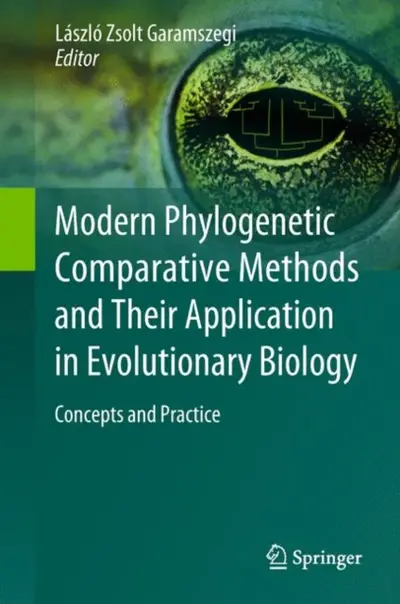
Modern Phylogenetic Comparative Methods and Their Application in Evolutionary Biology
Concepts and Practice
Price and availability
$107.99
Available in: Andorra, Austria, Australia, Belgium, Bulgaria, Canada, Switzerland, Cyprus, Czechia, Germany, Denmark, Estonia, Spain, Finland, France, United Kingdom, Guernsey, Greece, Croatia, Hungary, Ireland, Isle of Man, Iceland, Italy, Jersey, Japan, Liechtenstein, Lithuania, Luxembourg, Latvia, Monaco, Malta, Netherlands, Norway, Poland, Portugal, Romania, Sweden, Slovenia, Slovakia, San Marino, United States, Vatican City, South Africa
Stores: US, UK, Canada, EU, Australia.
Sign in to buyThe price is re-checked by the server before payment.
For personal use under the eBook licence.
- Format
- EPUB
- DRM
- Not stated by the publisher
- Language
- English
- Publisher
- Springer Berlin Heidelberg
- Published
- 29 July 2014
- ISBN
- 9783662435502
- Subjects
- Biology, life sciences, Ecological science, the Biosphere, Evolution, Molecular biology, Biodiversity, Life sciences: general issues, Ecological science, the Biosphere, Evolution / Evolutionary biology, Molecular biology, Biodiversity / Ecosystems
About this book
Phylogenetic comparative approaches are powerful analytical tools for making evolutionary inferences from interspecific data and phylogenies. The phylogenetic toolkit available to evolutionary biologists is currently growing at an incredible speed, but most methodological papers are published in the specialized statistical literature and many are incomprehensible for the user community. This textbook provides an overview of several newly developed phylogenetic comparative methods that allow to investigate a broad array of questions on how phenotypic characters evolve along the branches of phylogeny and how such mechanisms shape complex animal communities and interspecific interactions. The individual chapters were written by the leading experts in the field and using a language that is accessible for practicing evolutionary biologists. The authors carefully explain the philosophy behind different methodologies and provide pointers - mostly using a dynamically developing online interface - on how these methods can be implemented in practice. These "e;conceptual"e; and "e;practical"e; materials are essential for expanding the qualification of both students and scientists, but also offer a valuable resource for educators. Another value of the book are the accompanying online resources (available at: http://www.mpcm-evolution.com), where the authors post and permanently update practical materials to help embed methods into practice.
Bibliographic data © Gardners Books Ltd.