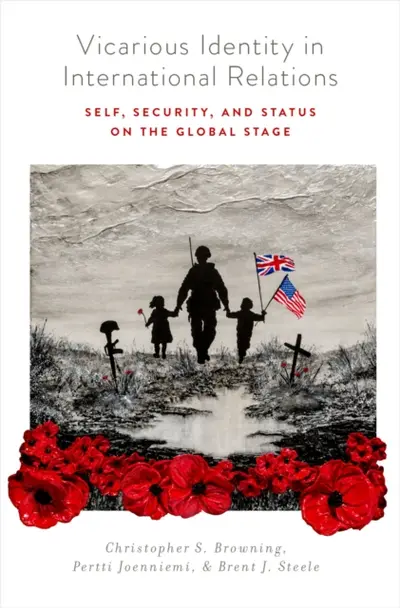
EPUB · English
Vicarious Identity in International Relations
Self, Security, and Status on the Global Stage
Price and availability
$78.99
Available in: Andorra, Austria, Australia, Belgium, Bulgaria, Canada, Switzerland, Cyprus, Czechia, Germany, Denmark, Estonia, Spain, Finland, France, United Kingdom, Guernsey, Greece, Croatia, Hungary, Ireland, Isle of Man, Iceland, Italy, Jersey, Japan, Liechtenstein, Lithuania, Luxembourg, Latvia, Monaco, Malta, Netherlands, Norway, Poland, Portugal, Romania, Sweden, Slovenia, Slovakia, San Marino, United States, Vatican City, South Africa
Stores: US, UK, Canada, EU, Australia.
Sign in to buyThe price is re-checked by the server before payment.
For personal use under the eBook licence.
- Format
- EPUB
- DRM
- Not stated by the publisher
- Language
- English
- Publisher
- Oxford University Press
- Published
- 19 January 2021
- ISBN
- 9780197526408
- Subjects
- Social & political philosophy, Political science & theory, International relations, Political science and theory, International relations, QDTS
About this book
Vicarious identification, or "e;living through another"e; is a familiar social-psychological concept. Shaped by insecurity and a lack of self-fulfilment, it refers to the processes by which actors gain a sense of self-identity, purpose, and self-esteem through appropriating the achievements and experiences of others. As this book argues, it is also an under-appreciated and increasingly relevant strategy of international relations. According to this theory, states identify and establish special relationships with other nations (often in an aspirational way) in order to strengthen their sense of self, security, and status on the global stage. This identification is also central to the politics of citizenship and can be manipulated by states to justify their global ambitions. For example, why might the United States look at Israel as a model for its own foreign policies? What shaped the politics of Brexit and why is the United Kingdom so attached to its transatlantic "e;special relationship"e; with the United States? And, why did Denmark so enthusiastically ally with the United States during the global War on Terror? Vicarious identity, as the authors argue, is at the core of these international dynamics. Vicarious Identity in International Relations examines the ways in which vicarious identity is relevant to global politics: across individuals; between citizens and states; and across states, regional communities, or civilizations. It looks at a range of cases (the United States, the United Kingdom, and Denmark), which illustrate that vicarious political identity is dynamic and emerges in different contexts, but particularly when nations face crisis, both internally and externally. In addition, the book outlines a qualitative methodology for analyzing vicarious identity at the collective level.
Bibliographic data © Gardners Books Ltd.