PDF · English
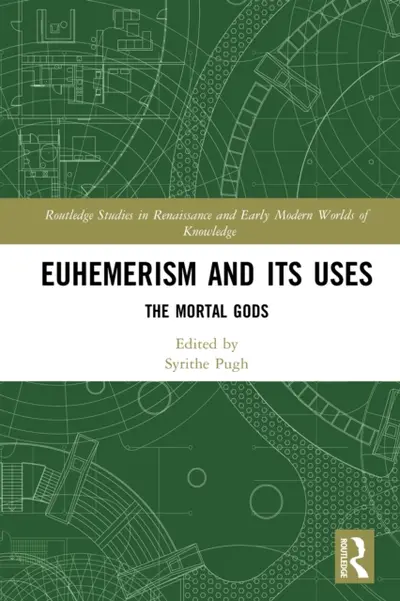
Euhemerism and Its Uses
The Mortal Gods
Price and availability
$52.99
Available in: Andorra, Austria, Australia, Belgium, Bulgaria, Canada, Switzerland, Cyprus, Czechia, Germany, Denmark, Estonia, Spain, Finland, France, United Kingdom, Guernsey, Greece, Croatia, Hungary, Ireland, Isle of Man, Iceland, Italy, Jersey, Japan, Liechtenstein, Lithuania, Luxembourg, Latvia, Monaco, Malta, Netherlands, Norway, Poland, Portugal, Romania, Sweden, Slovenia, Slovakia, San Marino, United States, Vatican City, South Africa
Stores: US, UK, Canada, EU, Australia.
Sign in to buyThe price is re-checked by the server before payment.
For personal use under the eBook licence.
- Format
- DRM
- Not stated by the publisher
- Language
- English
- Publisher
- Taylor & Francis
- Published
- 17 March 2021
- ISBN
- 9781000356588
- Subjects
- Literary studies: c 1500 to c 1800, Early modern history: c 1450/1500 to c 1700, Social & cultural history, Europe, Literary studies: ancient, classical and medieval, Interdisciplinary studies, Ancient history
About this book
Euhemerism and Its Uses offers the first interdisciplinary, focussed, and all-round view of the long history of an important but understudied phenomenon in European intellectual and cultural history. Euhemerism - the claim that the Greek gods were historically mortal men and women - originated in the early third century BCE, in an enigmatic and now fragmentary text by the otherwise unknown author Euhemeros. This work, the Sacred Inscription, has been read variously as a theory of religion, an atheist's manifesto, as justifying or satirizing ruler-worship, as a fantasy travel-narrative, and as an early 'utopia'. Influencing Hellenistic and Roman literature and religious and political thought, and appropriated by early Christians to debunk polytheism while simultaneously justifying the continued study of classical literature, euhemerism was widespread in the middle ages and Renaissance, and its reverberations continue to be felt in modern myth-theory. Yet, though frequently invoked as a powerful and pervasive tradition across several disciplines, it is still under-examined and poorly understood. Filling an important gap in the history of ideas, this volume will appeal to scholars and students of classical reception, mediaeval and Renaissance literature, historiography, and theories of myth and religion.
Bibliographic data © Gardners Books Ltd.