EPUB · English
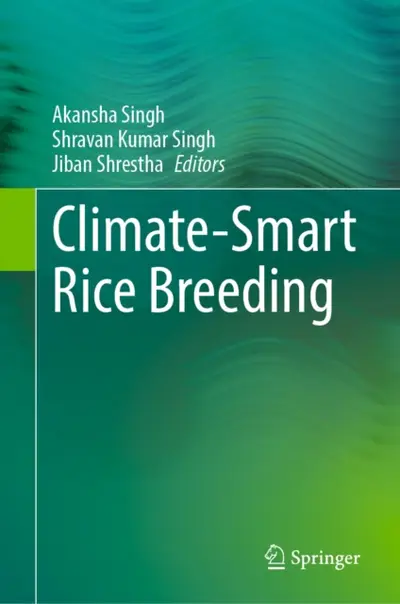
Climate-Smart Rice Breeding
Price and availability
$202.99
Available in: Andorra, Austria, Australia, Belgium, Bulgaria, Canada, Switzerland, Cyprus, Czechia, Germany, Denmark, Estonia, Spain, Finland, France, United Kingdom, Guernsey, Greece, Croatia, Hungary, Ireland, Isle of Man, Iceland, Italy, Jersey, Japan, Liechtenstein, Lithuania, Luxembourg, Latvia, Monaco, Malta, Netherlands, Norway, Poland, Portugal, Romania, Sweden, Slovenia, Slovakia, San Marino, United States, Vatican City, South Africa
Stores: US, UK, Canada, EU, Australia.
Sign in to buyThe price is re-checked by the server before payment.
For personal use under the eBook licence.
- Format
- EPUB
- DRM
- Not stated by the publisher
- Language
- English
- Publisher
- Springer Nature Singapore
- Published
- 15 November 2024
- ISBN
- 9789819770984
- Subjects
- Genetics (non-medical), Botany & plant sciences, Biotechnology, Agriculture & farming, Agricultural science, Agronomy & crop production, Genetics (non-medical), Plant biology, Biotechnology, Agricultural science, Agronomy and crop production
About this book
This book covers all aspects of smart-breeding technologies in creating novel crop architecture to meet future rice demand. Several advanced crop breeding technologies like, marker-assisted backcross breeding, marker-assisted recurrent selection, genomic assisted breeding, haplotype breeding and genome editing technologies have been introduced and employed for rice productivity improvement. Use of artificial intelligence and machine learning in crop phenotype prediction is paving the way for climate-smart breeding. Chapters in this volume cover all these relevant topics. The global rice demand is estimated to rise to 555 and 827.86 million tons in 2035 for milled rice and paddy, respectively. Enhancing high-nutrition rice production under the pressure of global climate change conditions is a hard task for breeders. Changing climatic scenarios and extreme weather conditions have increased the incidence of various biotic and abiotic stresses. Also, every degree rise in global mean temperature causes 3.2 % reduction in rice yield globally. This creates an urgent need for developing high-yielding rice varieties to tackle the aggravated issue of food security. This book is meant for scientists, professionals, researchers, and students working on enhancing rice production through advanced plant-breeding technologies.
Bibliographic data © Gardners Books Ltd.