EPUB · English
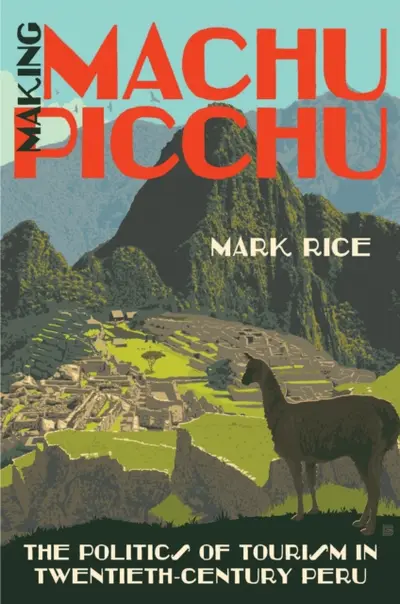
Making Machu Picchu
The Politics of Tourism in Twentieth-Century Peru
Price and availability
$155.99
Available in: Andorra, Austria, Australia, Belgium, Bulgaria, Canada, Switzerland, Cyprus, Czechia, Germany, Denmark, Estonia, Spain, Finland, France, United Kingdom, Guernsey, Greece, Croatia, Hungary, Ireland, Isle of Man, Iceland, Italy, Jersey, Japan, Liechtenstein, Lithuania, Luxembourg, Latvia, Monaco, Malta, Netherlands, Norway, Poland, Portugal, Romania, Sweden, Slovenia, Slovakia, San Marino, United States, Vatican City, South Africa
Stores: US, UK, Canada, EU, Australia.
Sign in to buyThe price is re-checked by the server before payment.
For personal use under the eBook licence.
- Format
- EPUB
- DRM
- Not stated by the publisher
- Language
- English
- Publisher
- The University of North Carolina Press
- Published
- 8 October 2018
- ISBN
- 9781469643557
- Subjects
- Latin America, History of the Americas, Conservation of the environment, Latin America – Mexico, Central America, South America, Peru, History of the Americas, Conservation of the environment, Travel and holiday
About this book
Speaking at a 1913 National Geographic Society gala, Hiram Bingham III, the American explorer celebrated for finding the lost city of the Andes two years earlier, suggested that Machu Picchu is an awful name, but it is well worth remembering. Millions of travelers have since followed Binghams advice. When Bingham first encountered Machu Picchu, the site was an obscure ruin. Now designated a UNESCO World Heritage Site, Machu Picchu is the focus of Perus tourism economy. Mark Rices history of Machu Picchu in the twentieth centuryfrom its discovery to todays travel boomreveals how Machu Picchu was transformed into both a global travel destination and a powerful symbol of the Peruvian nation.Rice shows how the growth of tourism at Machu Picchu swayed Peruvian leaders to celebrate Andean culture as compatible with their vision of a modernizing nation. Encompassing debates about nationalism, Indigenous peoples' experiences, and cultural policyas well as development and globalizationthe book explores the contradictions and ironies of Machu Picchus transformation. On a broader level, it calls attention to the importance of tourism in the creation of national identity in Peru and Latin America as a whole.
Bibliographic data © Gardners Books Ltd.