PDF · English
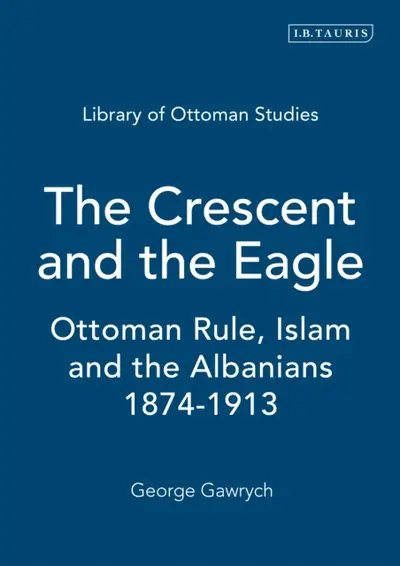
Crescent and the Eagle
Ottoman Rule, Islam and the Albanians, 1874-1913
Price and availability
$170.99
Available in: Andorra, Austria, Australia, Belgium, Bulgaria, Canada, Switzerland, Cyprus, Czechia, Germany, Denmark, Estonia, Spain, Finland, France, United Kingdom, Guernsey, Greece, Croatia, Hungary, Ireland, Isle of Man, Iceland, Italy, Jersey, Japan, Liechtenstein, Lithuania, Luxembourg, Latvia, Monaco, Malta, Netherlands, Norway, Poland, Portugal, Romania, Sweden, Slovenia, Slovakia, San Marino, United States, Vatican City, South Africa
Stores: US, UK, Canada, EU, Australia.
Sign in to buyThe price is re-checked by the server before payment.
For personal use under the eBook licence.
- Format
- DRM
- Not stated by the publisher
- Language
- English
- Publisher
- Bloomsbury Publishing
- Published
- 25 October 2006
- Pages
- 272
- ISBN
- 9781786734440
- Subjects
- Albania, European history, Modern history to 20th century: c 1700 to c 1900, 20th century history: c 1900 to c 2000, Politics & government, Politics and government, NH, NHD
About this book
"e;The Crescent and the Eagle"e; examines the awakening of Albanian national identity from the end of the 19th century to the outbreak of the First World War - a period of intense nationalism in the Balkans - from an Ottoman perspective. Drawing on Ottoman and European archival material, the book undermines the customary negative stereotypes of Ottoman rule, offering a more nuanced interpretation. Gawrych provides a critical but objective examination of the evolution of government policies toward Albanians, from attempts to mould them into an "e;iron barrier"e; to the establishment of a uniform system of administration. He argues that this was a result of a complicated set of conflicting allegiances and identities, rather than a simply adversarial struggle between government imposition of policy and Albanian resistance. The author also analyses the general problems of endemic violence and misadministration at the provincial level, and examines Albanian efforts to gain nationality rights and maintain local privileges and tribal autonomy.Weaving his analysis of these events into a chronological framework, he concludes that Albanian independence resulted from a confluence of foreign and domestic developments rather than from the design and will of the Albanians themselves. This stimulating study offers many fresh insights into the dynamics of power within the Ottoman Empire and contributes a new perspective to the study of the development of Albanian nationalism.
Bibliographic data © Gardners Books Ltd.