PDF · English
Protean Virgil
Material Form and the Reception of the Classics
Price and availability
$105.99
Available in: Andorra, Austria, Australia, Belgium, Bulgaria, Canada, Switzerland, Cyprus, Czechia, Germany, Denmark, Estonia, Spain, Finland, France, United Kingdom, Guernsey, Greece, Croatia, Hungary, Ireland, Isle of Man, Iceland, Italy, Jersey, Japan, Liechtenstein, Lithuania, Luxembourg, Latvia, Monaco, Malta, Netherlands, Norway, Poland, Portugal, Romania, Sweden, Slovenia, Slovakia, San Marino, United States, Vatican City, South Africa
Stores: US, UK, Canada, EU, Australia.
Sign in to buyThe price is re-checked by the server before payment.
For personal use under the eBook licence.
- Format
- DRM
- Not stated by the publisher
- Language
- English
- Publisher
- Oxford University Press
- Published
- 26 March 2015
- ISBN
- 9780191043642
- Subjects
- Ancient Rome, Latin, Literary studies: classical, early & medieval, Literary studies: poetry & poets, Ancient, classical and medieval texts, Literary studies: ancient, classical and medieval, Material culture, Ancient history, Social and cultural history
About this book
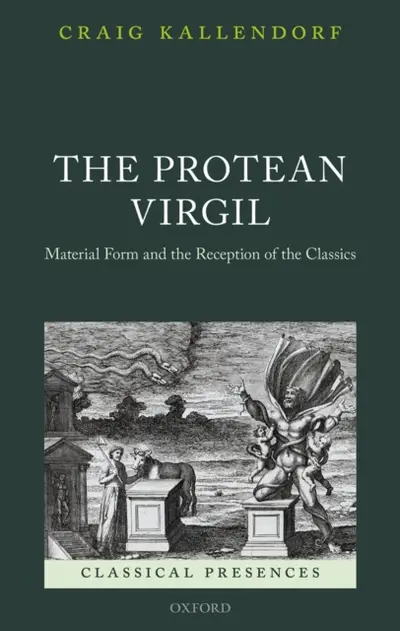
The Protean Virgil argues that when we try to understand how and why different readers have responded differently to the same text over time, we should take into account the physical form in which they read the text as well as the text itself. Using Virgil's poetry as a case study in book history, the volume shows that a succession of material forms - manuscript, printed book, illustrated edition, and computer file - undermines the drive toward textual and interpretive stability. This stability is the traditional goal of classical scholarship, which seeks to recover what Virgil wrote and how he intended it to be understood. The manuscript form served to embed Virgil's poetry into Christian culture, which attempted to anchor the content into a compatible theological truth. Readers of early printed material proceeded differently, breaking Virgil's text into memorable moral and stylistic fragments, and collecting those fragments into commonplace books. Furthermore, early illustrated editions present a progression of re-envisionings in which Virgil's poetry was situated within a succession of receiving cultures. In each case, however, the material form helped to generate a method of reading Virgil which worked with this form but which failed to survive the transition to a new union of the textual and the physical. This form-induced instability reaches its climax with computerization, which allows the reader new power to edit the text and to challenge the traditional association of Virgil's poetry with elite culture.
Bibliographic data © Gardners Books Ltd.