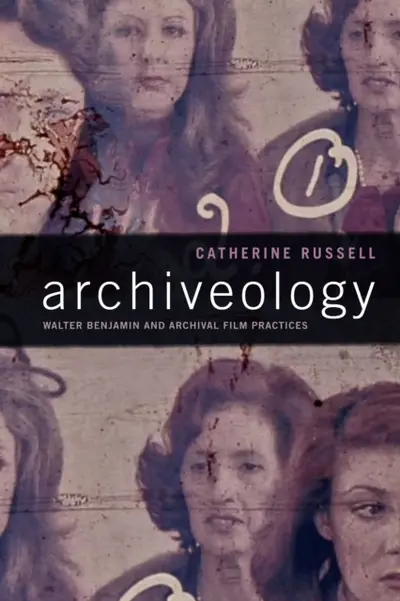
PDF · English
Archiveology
Walter Benjamin and Archival Film Practices
Price and availability
$47.99
Available in: Andorra, Austria, Australia, Belgium, Bulgaria, Canada, Switzerland, Cyprus, Czechia, Germany, Denmark, Estonia, Spain, Finland, France, United Kingdom, Guernsey, Greece, Croatia, Hungary, Ireland, Isle of Man, Iceland, Italy, Jersey, Japan, Liechtenstein, Lithuania, Luxembourg, Latvia, Monaco, Malta, Netherlands, Norway, Poland, Portugal, Romania, Sweden, Slovenia, Slovakia, San Marino, United States, Vatican City, South Africa
Stores: US, UK, Canada, EU, Australia.
Sign in to buyThe price is re-checked by the server before payment.
For personal use under the eBook licence.
- Format
- DRM
- Not stated by the publisher
- Language
- English
- Publisher
- Duke University Press
- Published
- 15 March 2018
- ISBN
- 9780822372004
- Subjects
- Electronic, holographic & video art, Film theory & criticism, Library & information sciences, Digital, video and new media arts, ATFA, Library and information sciences / Museology
About this book
In Archiveology Catherine Russell uses the work of Walter Benjamin to explore how the practice of archiveology-the reuse, recycling, appropriation, and borrowing of archival sounds and images by filmmakers-provides ways to imagine the past and the future. Noting how the film archive does not function simply as a place where moving images are preserved, Russell examines a range of films alongside Benjamin's conceptions of memory, document, excavation, and historiography. She shows how city films such as Nicole Vedres's Paris 1900 (1947) and Thom Andersen's Los Angeles Plays Itself (2003) reconstruct notions of urban life and uses Christian Marclay's The Clock (2010) to draw parallels between critical cinephilia and Benjamin's theory of the phantasmagoria. Russell also discusses practices of collecting in archiveological film and rereads films by Joseph Cornell and Rania Stephan to explore an archival practice that dislocates and relocates the female image in film. In so doing, she not only shows how Benjamin's work is as relevant to film theory as ever; she shows how archiveology can awaken artists and audiences to critical forms of history and memory.
Bibliographic data © Gardners Books Ltd.