PDF · English
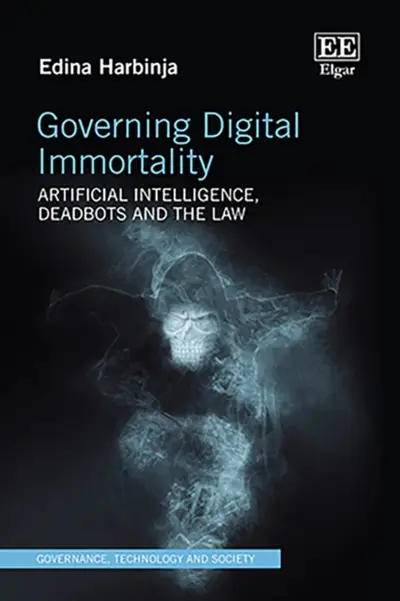
Governing Digital Immortality
Artificial Intelligence, Deadbots and the Law
Price and availability
$33.99
Available in: Andorra, Austria, Australia, Belgium, Bulgaria, Canada, Switzerland, Cyprus, Czechia, Germany, Denmark, Estonia, Spain, Finland, France, United Kingdom, Guernsey, Greece, Croatia, Hungary, Ireland, Isle of Man, Iceland, Italy, Jersey, Japan, Liechtenstein, Lithuania, Luxembourg, Latvia, Monaco, Malta, Netherlands, Norway, Poland, Portugal, Romania, Sweden, Slovenia, Slovakia, San Marino, United States, Vatican City, South Africa
Stores: US, UK, Canada, EU, Australia.
Sign in to buyThe price is re-checked by the server before payment.
For personal use under the eBook licence.
- Format
- DRM
- Not stated by the publisher
- Language
- English
- Publisher
- Edward Elgar Publishing
- Published
- 18 September 2026
- ISBN
- 9781035365593
- Subjects
- IT & Communications law, Legal aspects of IT, Artificial intelligence, Digital, IT and Communications law, Digital and information technologies: Legal aspects, Artificial intelligence (AI)
About this book
This timely book explores a growing and underregulated phenomenon: the use of artificial intelligence to recreate people after their deaths. Moving beyond fragmented discussions of digital legacy, privacy, or synthetic media, Edina Harbinja's comparative analysis investigates the complex legality of AI systems that simulate the deceased.Despite promising comfort, legacy, or even a form of digital immortality, this book addresses the challenging questions AI technologies raise: Who has the right to create such simulations of the deceased? What happens if someone is recreated without consent? Can companies profit from grief? How do these systems affect families, memory, and trust? Harbinja promotes an understanding of AI systems that simulate the dead not only as data tools but as relationship-like systems requiring safeguards. She further outlines why existing laws around consumer protection, privacy, data protection, AI law and regulation and online safety are insufficient to address the challenges posed by AI developments. Moving beyond theory, the book proposes practical, rights-based legal frameworks to protect dignity, prevent exploitation, and ensure that remembrance remains obligated to consent and care.A prescient and thought-provoking account, Governing Digital Immortality is a vital resource for scholars of technology law, AI law and regulation, data protection, and human rights law. Given its practical implementation and enforcement blueprint, policymakers and regulators in AI governance, online safety, and consumer protection will find this book equally beneficial.
Bibliographic data © Gardners Books Ltd.