EPUB · English
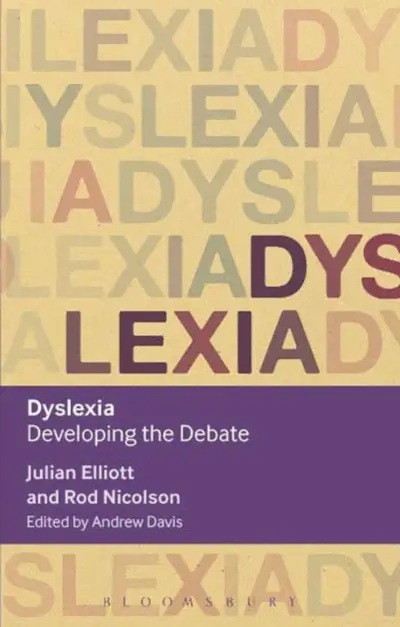
Dyslexia
Developing the Debate
Price and availability
$35.99
Available in: Andorra, Austria, Australia, Belgium, Bulgaria, Canada, Switzerland, Cyprus, Czechia, Germany, Denmark, Estonia, Spain, Finland, France, United Kingdom, Guernsey, Greece, Croatia, Hungary, Ireland, Isle of Man, Iceland, Italy, Jersey, Japan, Liechtenstein, Lithuania, Luxembourg, Latvia, Monaco, Malta, Netherlands, Norway, Poland, Portugal, Romania, Sweden, Slovenia, Slovakia, San Marino, United States, Vatican City, South Africa
Stores: US, UK, Canada, EU, Australia.
Sign in to buyThe price is re-checked by the server before payment.
For personal use under the eBook licence.
- Format
- EPUB
- DRM
- Not stated by the publisher
- Language
- English
- Publisher
- Bloomsbury Publishing
- Published
- 19 May 2016
- Pages
- 224
- ISBN
- 9781474233736
- Subjects
- Philosophy & theory of education, Teaching of specific groups & persons with special educational needs, Teaching of dyslexic students, Philosophy and theory of education, Teaching of students with different educational needs, JNSG
About this book
Dyslexia is often presented as a clearly delineated condition that can be diagnosed on the basis of appropriate cognitive tests with corresponding forms on intervention. However, this approachable text explores the issues behind this assertion in bringing together leading figures in the field to debate dyslexia.Julian Elliott shows that understandings and usage of the dyslexia label vary substantially with little consensus or agreement and in putting forward his critique draws upon research in several disciplinary fields to demonstrate the irrationality of these arguments. Roderick I. Nicolson demonstrates that current approaches to understanding, identification and support of dyslexia are catastrophically flawed in terms of their failure to consider the developmental nature of dyslexia. He develops two themes: first that the underlying cause of dyslexia is 'delayed neural commitment' for skills and neural circuits, and second that the cause of the reading disability is the introduction of formal instruction before the dyslexic child's neural circuits for executive function are sufficiently developed. He argues that a more effective and cost-effective approach to identification and support involves 'assessment for dyslexia' rather than 'of dyslexia'. Elliott and Nicolson respond to the points each other raise before Andrew Davis investigates how far the key claims of Elliott and Nicolson can withstand close conceptual investigation, and explores the inherent limitations of scientific research on this topic, given the value and conceptual issues concerned.
Bibliographic data © Gardners Books Ltd.