PDF · English
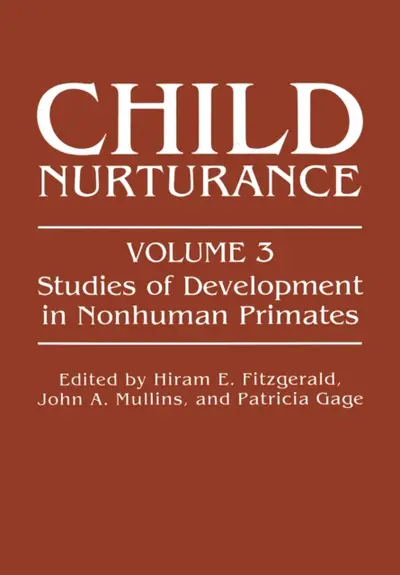
Child Nurturance
Studies of Development in Nonhuman Primates
Price and availability
$60.99
Available in: Andorra, Austria, Australia, Belgium, Bulgaria, Canada, Switzerland, Cyprus, Czechia, Germany, Denmark, Estonia, Spain, Finland, France, United Kingdom, Guernsey, Greece, Croatia, Hungary, Ireland, Isle of Man, Iceland, Italy, Jersey, Japan, Liechtenstein, Lithuania, Luxembourg, Latvia, Monaco, Malta, Netherlands, Norway, Poland, Portugal, Romania, Sweden, Slovenia, Slovakia, San Marino, United States, Vatican City, South Africa
Stores: US, UK, Canada, EU, Australia.
Sign in to buyThe price is re-checked by the server before payment.
For personal use under the eBook licence.
- Format
- DRM
- Not stated by the publisher
- Language
- English
- Publisher
- Springer US
- Published
- 6 December 2012
- ISBN
- 9781461336051
- Subjects
- Psychology, Psychology
About this book
The underlying theme uniting the papers of this volume is the quest for a further understanding of human behavior. The similarities between the behaviors of other primates and humans have captivated us even before a science arose. But what is the justification for making such comparisons? Comparisons, like classifications, can be made on any basis whatever. The aim in making any scientific comparison is the same as doing a classification. That is, one attempts to make the comparison on a "e;natural"e; basis. Natural, in this case, means that the comparison reflects processes that occur in nature. The fundamental paradigm for making natural comparisons in biology is based on evolutionary theory. The evolutionary paradigm is inherently one of comparisons between and within species. Conversely, it is impossible to begin to make cross species comparisons without making, implicitly at least, evolutionary arguments. But evolution is a complex construct of theories (Lewis, 1980), and comparisons can be made out of different theoretical bases. F or the sake of this discussion we can combine varieties of sub-theories into two categories: those having to do with descent with modification, and those concerned with the mechanics of evolutionary change--notably natural selection.
Bibliographic data © Gardners Books Ltd.