EPUB · English
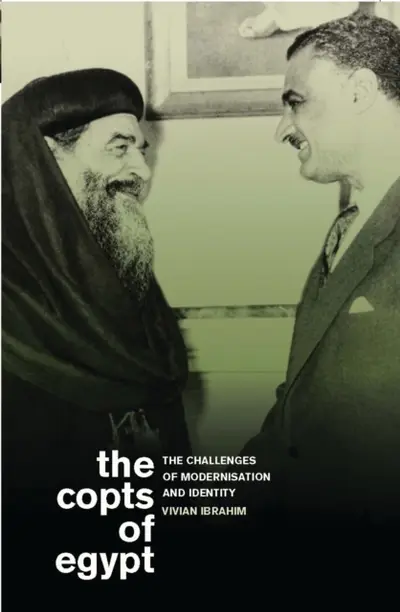
Copts of Egypt
The Challenges of Modernisation and Identity
Price and availability
$40.99
Available in: Andorra, Austria, Australia, Belgium, Bulgaria, Canada, Switzerland, Cyprus, Czechia, Germany, Denmark, Estonia, Spain, Finland, France, United Kingdom, Guernsey, Greece, Croatia, Hungary, Ireland, Isle of Man, Iceland, Italy, Jersey, Japan, Liechtenstein, Lithuania, Luxembourg, Latvia, Monaco, Malta, Netherlands, Norway, Poland, Portugal, Romania, Sweden, Slovenia, Slovakia, San Marino, United States, Vatican City, South Africa
Stores: US, UK, Canada, EU, Australia.
Sign in to buyThe price is re-checked by the server before payment.
For personal use under the eBook licence.
- Format
- EPUB
- DRM
- Not stated by the publisher
- Language
- English
- Publisher
- Bloomsbury Publishing
- Published
- 2 December 2010
- Pages
- 272
- ISBN
- 9780857736321
- Subjects
- Egypt, 20th century, Asian history, Middle Eastern history, Modern history to 20th century: c 1700 to c 1900, 20th century history: c 1900 to c 2000, Social & cultural history, Religion & beliefs, Religion & politics, Orthodox & Oriental Churches, Christian institutions & organizations, Religious institutions & organizations, Islamic studies, Politics & government, 3MP, JBSR, Politics and government, NH, NHF, NHG, NHTB, QR, QRAM2, QRM, QRMB2, QRVS
About this book
The Coptic Christians of Egypt have traditionally been portrayed as a 'beleaguered minority', persecuted in a Muslim majority state and by the threat of political Islam. Vivian Ibrahim offers a vivid portrayal of the community and an alternative interpretation of Coptic agency in the twentieth century, through newly dicovered sources. Dismissing the monolithic portrayal of this community, she analyses how Copts negotiated a role for themselves during the colonial and Nasserist periods, and their multifaceted response to the emergence of the Muslim Brotherhood. She examines reform within the Church itself, and how it led to power struggles that redefined the role of the Pope and Church in Nasser's Egypt. The findings of this book hold great relevance for understanding identity politics and the place of the Coptic community in the fast-changing political landscape of today's Egypt.
Bibliographic data © Gardners Books Ltd.