PDF · English
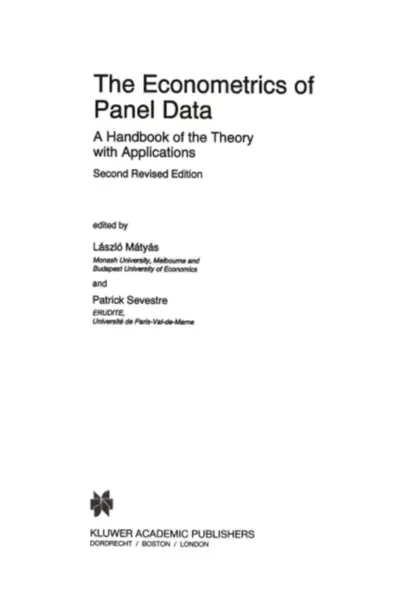
Econometrics of Panel Data
A Handbook of the Theory with Applications
Price and availability
$175.99
Available in: Andorra, Austria, Australia, Belgium, Bulgaria, Canada, Switzerland, Cyprus, Czechia, Germany, Denmark, Estonia, Spain, Finland, France, United Kingdom, Guernsey, Greece, Croatia, Hungary, Ireland, Isle of Man, Iceland, Italy, Jersey, Japan, Liechtenstein, Lithuania, Luxembourg, Latvia, Monaco, Malta, Netherlands, Norway, Poland, Portugal, Romania, Sweden, Slovenia, Slovakia, San Marino, United States, Vatican City, South Africa
Stores: US, UK, Canada, EU, Australia.
Sign in to buyThe price is re-checked by the server before payment.
For personal use under the eBook licence.
- Format
- DRM
- Not stated by the publisher
- Language
- English
- Publisher
- Springer Netherlands
- Published
- 1 December 2013
- ISBN
- 9789400901377
- Subjects
- Econometrics, Econometrics and economic statistics
About this book
The aim of this volume is to provide a general overview of the econometrics of panel data, both from a theoretical and from an applied viewpoint. Since the pioneering papers by Edwin Kuh (1959), Yair Mundlak (1961), Irving Hoch (1962), and Pietro Balestra and Marc Nerlove (1966), the pooling of cross sections and time series data has become an increasingly popular way of quantifying economic relationships. Each series provides information lacking in the other, so a combination of both leads to more accurate and reliable results than would be achievable by one type of series alone. Over the last 30 years much work has been done: investigation of the properties of the applied estimators and test statistics, analysis of dynamic models and the effects of eventual measurement errors, etc. These are just some of the problems addressed by this work. In addition, some specific diffi- culties associated with the use of panel data, such as attrition, heterogeneity, selectivity bias, pseudo panels etc., have also been explored. The first objective of this book, which takes up Parts I and II, is to give as complete and up-to-date a presentation of these theoretical developments as possible. Part I is concerned with classical linear models and their extensions; Part II deals with nonlinear models and related issues: logit and pro bit models, latent variable models, duration and count data models, incomplete panels and selectivity bias, point processes, and simulation techniques.
Bibliographic data © Gardners Books Ltd.