PDF · English
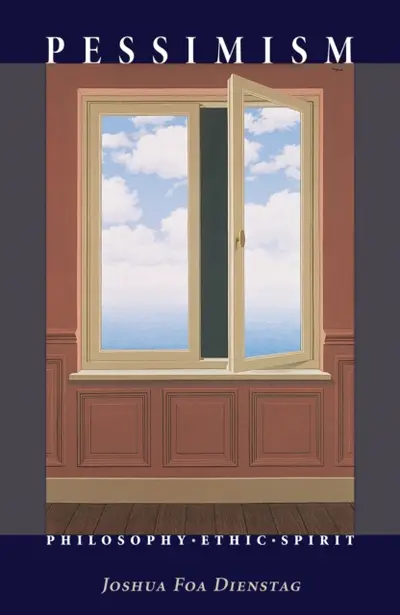
Pessimism
Philosophy, Ethic, Spirit
Price and availability
$56.99
Available in: Andorra, Austria, Australia, Belgium, Bulgaria, Canada, Switzerland, Cyprus, Czechia, Germany, Denmark, Estonia, Spain, Finland, France, United Kingdom, Guernsey, Greece, Croatia, Hungary, Ireland, Isle of Man, Iceland, Italy, Jersey, Japan, Liechtenstein, Lithuania, Luxembourg, Latvia, Monaco, Malta, Netherlands, Norway, Poland, Portugal, Romania, Sweden, Slovenia, Slovakia, San Marino, United States, Vatican City, South Africa
Stores: US, UK, Canada, EU, Australia.
Sign in to buyThe price is re-checked by the server before payment.
For personal use under the eBook licence.
- Format
- DRM
- Not stated by the publisher
- Language
- English
- Publisher
- Princeton University Press
- Published
- 17 February 2009
- ISBN
- 9781400827480
- Subjects
- Philosophy, History of Western philosophy, Social & political philosophy, History of ideas, Political science & theory, Political science and theory, Philosophical traditions and schools of thought, Social and political philosophy
About this book
Pessimism claims an impressive following--from Rousseau, Schopenhauer, and Nietzsche, to Freud, Camus, and Foucault. Yet "e;pessimist"e; remains a term of abuse--an accusation of a bad attitude--or the diagnosis of an unhappy psychological state. Pessimism is thought of as an exclusively negative stance that inevitably leads to resignation or despair. Even when pessimism looks like utter truth, we are told that it makes the worst of a bad situation. Bad for the individual, worse for the species--who would actually counsel pessimism? Joshua Foa Dienstag does. In Pessimism, he challenges the received wisdom about pessimism, arguing that there is an unrecognized yet coherent and vibrant pessimistic philosophical tradition. More than that, he argues that pessimistic thought may provide a critically needed alternative to the increasingly untenable progressivist ideas that have dominated thinking about politics throughout the modern period. Laying out powerful grounds for pessimism's claim that progress is not an enduring feature of human history, Dienstag argues that political theory must begin from this predicament. He persuasively shows that pessimism has been--and can again be--an energizing and even liberating philosophy, an ethic of radical possibility and not just a criticism of faith. The goal--of both the pessimistic spirit and of this fascinating account of pessimism--is not to depress us, but to edify us about our condition and to fortify us for life in a disordered and disenchanted universe.
Bibliographic data © Gardners Books Ltd.