EPUB · English
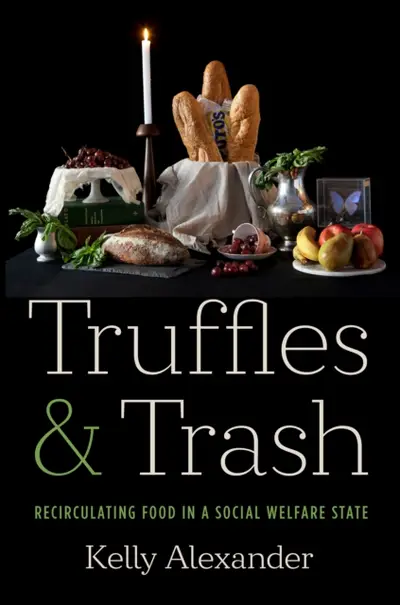
Truffles and Trash
Recirculating Food in a Social Welfare State
Price and availability
$168.99
Available in: Andorra, Austria, Australia, Belgium, Bulgaria, Canada, Switzerland, Cyprus, Czechia, Germany, Denmark, Estonia, Spain, Finland, France, United Kingdom, Guernsey, Greece, Croatia, Hungary, Ireland, Isle of Man, Iceland, Italy, Jersey, Japan, Liechtenstein, Lithuania, Luxembourg, Latvia, Monaco, Malta, Netherlands, Norway, Poland, Portugal, Romania, Sweden, Slovenia, Slovakia, San Marino, United States, Vatican City, South Africa
Stores: US, UK, Canada, EU, Australia.
Sign in to buyThe price is re-checked by the server before payment.
For personal use under the eBook licence.
- Format
- EPUB
- DRM
- Not stated by the publisher
- Language
- English
- Publisher
- The University of North Carolina Press
- Published
- 29 October 2024
- ISBN
- 9781469678610
- Subjects
- Food & society, Social & cultural anthropology, ethnography, Non-governmental organizations (NGOs), Cultural studies: food and society, Social and cultural anthropology, Non-governmental organizations (NGOs)
About this book
On a fragile planet with spreading food insecurity, food waste is a political and ethical problem. Examining the collaborative, sometimes scrappy institutional and community efforts to recuperate and redistribute food waste in Brussels, Belgium, Kelly Alexander reveals it is also an opportunity for new forms of sociality. Her study plays out across a diverse set of locationsincluding a food bank with ties to the EU, a social restaurant serving low-cost meals made from supermarket surplus by an emergent immigrant labor force, and a social inclusion program in an urban market with a zero food waste pop-up caf. Alexander argues that these efforts, in concert with innovative policy, effectively recirculate wasted food to new publics and produce what she terms a spectrum of edibility.According to Alexander, these models face challengesincluding reproducing the very power dynamics across race, class, and citizenship status they seek to circumvent. They also mirror the challenges of the everyday operations of the European social welfare state, which is increasingly reliant on NGOs to meet provisioning promises. Yet she finds that they also move the needle forward to reduce food waste across one city, providing an example for major urban centers around the world.
Bibliographic data © Gardners Books Ltd.