EPUB · English
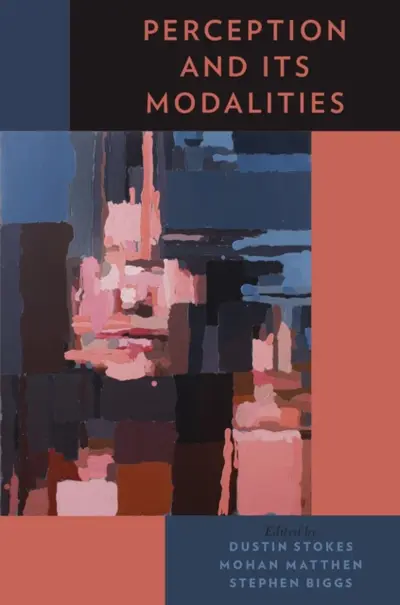
Perception and Its Modalities
Price and availability
$48.99
Available in: Andorra, Austria, Australia, Belgium, Bulgaria, Canada, Switzerland, Cyprus, Czechia, Germany, Denmark, Estonia, Spain, Finland, France, United Kingdom, Guernsey, Greece, Croatia, Hungary, Ireland, Isle of Man, Iceland, Italy, Jersey, Japan, Liechtenstein, Lithuania, Luxembourg, Latvia, Monaco, Malta, Netherlands, Norway, Poland, Portugal, Romania, Sweden, Slovenia, Slovakia, San Marino, United States, Vatican City, South Africa
Stores: US, UK, Canada, EU, Australia.
Sign in to buyThe price is re-checked by the server before payment.
For personal use under the eBook licence.
- Format
- EPUB
- DRM
- Not stated by the publisher
- Language
- English
- Publisher
- Oxford University Press
- Published
- 28 August 2014
- ISBN
- 9780199381616
- Subjects
- Philosophy of mind, Cognition & cognitive psychology, Perception, Cognition and cognitive psychology, QDTM
About this book
This volume is about the many ways we perceive. In nineteen new essays, philosophers and cognitive scientists explore the nature of the individual senses, how and what they tell us about the world, and how they interrelate. They consider how the senses extract perceptual content from receptoral information and what kinds of objects we perceive and whether multiple senses ever perceive a single event. Questions pertaining to how many senses we have, what makes one sense distinct from another, and whether and why distinguishing senses may be useful feature prominently. Contributors examine the extent to which the senses act in concert, rather than as discrete modalities, and whether this influence is epistemically pernicious, neutral, or beneficial. Many of the essays engage with the idea that it is unduly restrictive to think of perception as a collation of contents provided by individual sense modalities. Rather, contributors contend that to understand perception properly we need to build into our accounts the idea that the senses work together. In doing so, they aim to develop better paradigms for understanding the senses and thereby to move toward a better understanding of perception.
Bibliographic data © Gardners Books Ltd.