PDF · English
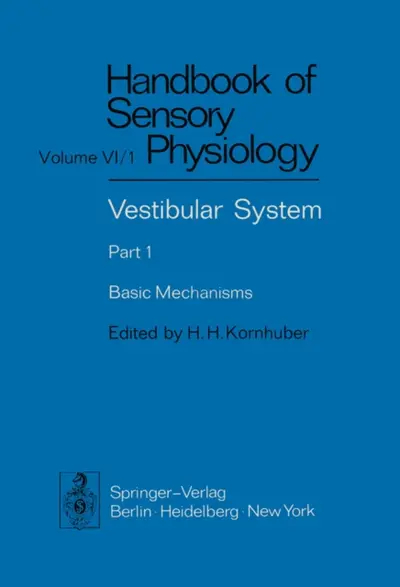
Vestibular System Part 1: Basic Mechanisms
Price and availability
$120.99
Available in: Andorra, Austria, Australia, Belgium, Bulgaria, Canada, Switzerland, Cyprus, Czechia, Germany, Denmark, Estonia, Spain, Finland, France, United Kingdom, Guernsey, Greece, Croatia, Hungary, Ireland, Isle of Man, Iceland, Italy, Jersey, Japan, Liechtenstein, Lithuania, Luxembourg, Latvia, Monaco, Malta, Netherlands, Norway, Poland, Portugal, Romania, Sweden, Slovenia, Slovakia, San Marino, United States, Vatican City, South Africa
Stores: US, UK, Canada, EU, Australia.
Sign in to buyThe price is re-checked by the server before payment.
For personal use under the eBook licence.
- Format
- DRM
- Not stated by the publisher
- Language
- English
- Publisher
- Springer Berlin Heidelberg
- Published
- 6 December 2012
- ISBN
- 9783642659423
- Subjects
- Medicine: general issues, Physiology, Human biology, Medicine / Healthcare: general issues / topics, Physiology
About this book
The details of the receptor mechanism are not yet fully understood for any sensory system. However, sufficient data are available (for the vestibular system and for other systems) to permit meaningful tracking of the sensory messages through the nervous system and via conscious experience. The reception, process- ing, storage and output of information in man and other animals, as done by means of receptors, neurons, secretory cells and muscle fibers, are collectively referred to as mind. Sensory physiologists tend to disbelieve in extrasensory perception. Sensory physiology in general is an area upon which different sciences and methods converge. Anatomists, physiologists, psychologists, physicists, chemists, and engineers have made important contributions to sensory physiology. What is special about vestibular physiology is the fact that many research workers are clinicians, living under the constant pressure of their patient's demands. This is a disadvantage when it comes to writing handbooks, but an advantage for the pa- tient, since research is guided by clinical practice and can be quickly applied. Modern methods, such as recording from single nerve units and the correlation of electrophysiological and psychophysical data, have greatly contributed to our knowledge, yet the study of lesions is still important, especially in the vestibular field.
Bibliographic data © Gardners Books Ltd.