EPUB · English
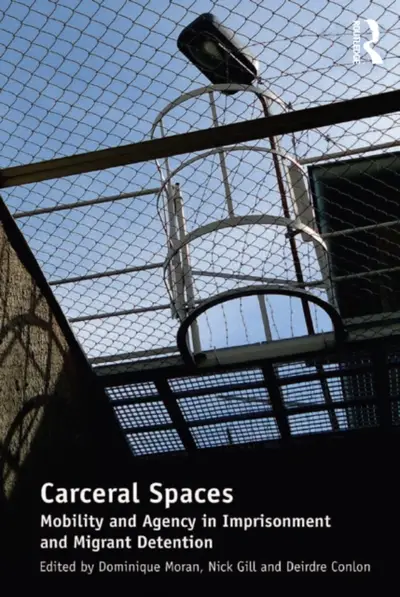
Carceral Spaces
Mobility and Agency in Imprisonment and Migrant Detention
Price and availability
$78.99
Available in: Andorra, Austria, Australia, Belgium, Bulgaria, Canada, Switzerland, Cyprus, Czechia, Germany, Denmark, Estonia, Spain, Finland, France, United Kingdom, Guernsey, Greece, Croatia, Hungary, Ireland, Isle of Man, Iceland, Italy, Jersey, Japan, Liechtenstein, Lithuania, Luxembourg, Latvia, Monaco, Malta, Netherlands, Norway, Poland, Portugal, Romania, Sweden, Slovenia, Slovakia, San Marino, United States, Vatican City, South Africa
Stores: US, UK, Canada, EU, Australia.
Sign in to buyThe price is re-checked by the server before payment.
For personal use under the eBook licence.
- Format
- EPUB
- DRM
- Not stated by the publisher
- Language
- English
- Publisher
- Taylor & Francis
- Published
- 15 April 2016
- ISBN
- 9781317169741
- Subjects
- Migration, immigration & emigration, Crime & criminology, Prisons, Criminal law & procedure, Geography, Human geography, Political geography, Penology and punishment, Population and migration geography, Social geography
About this book
This book draws together the work of a new community of scholars with a growing interest in carceral geography: the geographical study of practices of imprisonment and detention. It combines work by geographers on 'mainstream' penal establishments where people are incarcerated by the prevailing legal system, with geographers' recent work on migrant detention centres, where irregular migrants and 'refused' asylum seekers are detained, ostensibly pending decisions on admittance or repatriation. Working in these contexts, the book's contributors investigate the geographical location and spatialities of institutions, the nature of spaces of incarceration and detention and experiences inside them, governmentality and prisoner agency, cultural geographies of penal spaces, and mobility in the carceral context. In dialogue with emergent and topical agendas in geography around mobility, space and agency, and in relation to international policy challenges such as the (dis)functionality of imprisonment and the search for alternatives to detention, this book presents a timely addition to emergent interdisciplinary scholarship that will prompt dialogue among those working in geography, criminology and prison sociology.
Bibliographic data © Gardners Books Ltd.