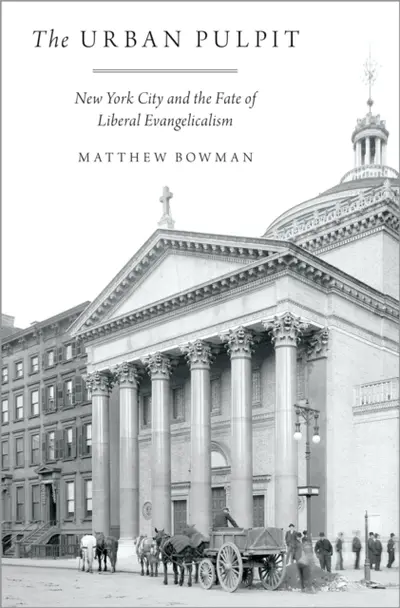
PDF · English
Urban Pulpit
New York City and the Fate of Liberal Evangelicalism
Price and availability
$68.99
Available in: Andorra, Austria, Australia, Belgium, Bulgaria, Canada, Switzerland, Cyprus, Czechia, Germany, Denmark, Estonia, Spain, Finland, France, United Kingdom, Guernsey, Greece, Croatia, Hungary, Ireland, Isle of Man, Iceland, Italy, Jersey, Japan, Liechtenstein, Lithuania, Luxembourg, Latvia, Monaco, Malta, Netherlands, Norway, Poland, Portugal, Romania, Sweden, Slovenia, Slovakia, San Marino, United States, Vatican City, South Africa
Stores: US, UK, Canada, EU, Australia.
Sign in to buyThe price is re-checked by the server before payment.
For personal use under the eBook licence.
- Format
- DRM
- Not stated by the publisher
- Language
- English
- Publisher
- Oxford University Press
- Published
- 4 February 2014
- ISBN
- 9780199977611
- Subjects
- USA, Southeastern & South Atlantic states, History of religion, Christian mission & evangelism, United States of America, USA, 1KBB-US-SE, QRAX, QRM
About this book
Matthew Bowman explores the world of a neglected group of American Christians: the self-identified liberal evangelicals who began in late nineteenth-century New York to reconcile traditional evangelical spirituality with progressive views on social activism and theological questions. These evangelicals emphasized the importance of supernatural conversion experience, but also argued that scientific advances, new movements in art, and the decline in poverty created by a new industrial economy could facilitate encounters with Christ. The Urban Pulpit chronicles the struggle of liberal evangelicals against conservative Protestants who questioned their theological sincerity and against secular reformers who grew increasingly devoted to the cause of cultural pluralism and increasingly suspicious of evangelicals over the course of the twentieth century. Liberal evangelicals walked a difficult path, facing increasing polarization in twentieth-century American public life; both conservative evangelicals and secular reformers insisted that religion and science were necessarily at odds and that evangelical Christianity was incompatible with cultural diversity. Liberal evangelicals rejected these simple dichotomies, but nonetheless found it increasingly difficult to defend their middle way. Drawing on history, anthropology, and religious studies, Bowman paints a complex portrait of these understudied Christians at work, at worship, and engaged in advocacy in the public square.
Bibliographic data © Gardners Books Ltd.