PDF · English
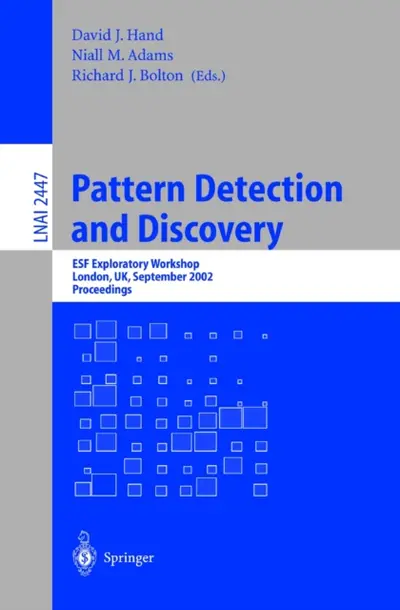
Pattern Detection and Discovery
ESF Exploratory Workshop, London, UK, September 16-19, 2002.
Price and availability
$60.99
Available in: Andorra, Austria, Australia, Belgium, Bulgaria, Canada, Switzerland, Cyprus, Czechia, Germany, Denmark, Estonia, Spain, Finland, France, United Kingdom, Guernsey, Greece, Croatia, Hungary, Ireland, Isle of Man, Iceland, Italy, Jersey, Japan, Liechtenstein, Lithuania, Luxembourg, Latvia, Monaco, Malta, Netherlands, Norway, Poland, Portugal, Romania, Sweden, Slovenia, Slovakia, San Marino, United States, Vatican City, South Africa
Stores: US, UK, Canada, EU, Australia.
Sign in to buyThe price is re-checked by the server before payment.
For personal use under the eBook licence.
- Format
- DRM
- Not stated by the publisher
- Language
- English
- Publisher
- Springer Berlin Heidelberg
- Published
- 2 August 2003
- ISBN
- 9783540457282
- Subjects
- Information theory, Probability & statistics, Computer programming / software development, Algorithms & data structures, Databases, Data capture & analysis, Information retrieval, Computer science, Artificial intelligence, Pattern recognition, Information theory, Probability and statistics, Algorithms and data structures, Databases / Data management, Data warehousing, Information retrieval, Maths for computer scientists, Artificial intelligence (AI)
About this book
The collation of large electronic databases of scienti?c and commercial infor- tion has led to a dramatic growth of interest in methods for discovering struc- res in such databases. These methods often go under the general name of data mining. One important subdiscipline within data mining is concerned with the identi?cation and detection of anomalous, interesting, unusual, or valuable - cords or groups of records, which we call patterns. Familiar examples are the detection of fraud in credit-card transactions, of particular coincident purchases in supermarket transactions, of important nucleotide sequences in gene sequence analysis, and of characteristic traces in EEG records. Tools for the detection of such patterns have been developed within the data mining community, but also within other research communities, typically without an awareness that the - sic problem was common to many disciplines. This is not unreasonable: each of these disciplines has a large literature of its own, and a literature which is growing rapidly. Keeping up with any one of these is di?cult enough, let alone keeping up with others as well, which may in any case be couched in an - familiar technical language. But, of course, this means that opportunities are being lost, discoveries relating to the common problem made in one area are not transferred to the other area, and breakthroughs and problem solutions are being rediscovered, or not discovered for a long time, meaning that e?ort is being wasted and opportunities may be lost.
Bibliographic data © Gardners Books Ltd.