EPUB · English
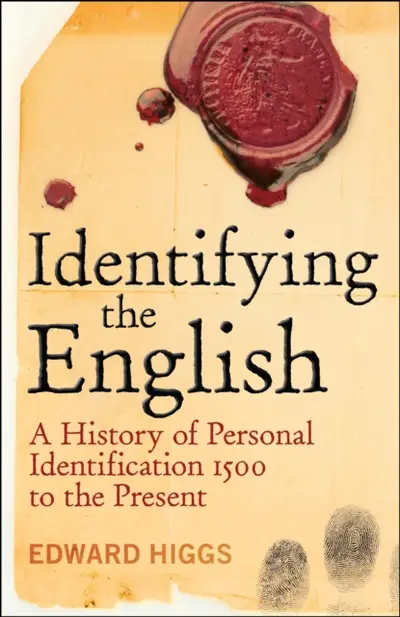
Identifying the English
A History of Personal Identification 1500 to the Present
Price and availability
$79.99
Available in: Andorra, Austria, Australia, Belgium, Bulgaria, Canada, Switzerland, Cyprus, Czechia, Germany, Denmark, Estonia, Spain, Finland, France, United Kingdom, Guernsey, Greece, Croatia, Hungary, Ireland, Isle of Man, Iceland, Italy, Jersey, Japan, Liechtenstein, Lithuania, Luxembourg, Latvia, Monaco, Malta, Netherlands, Norway, Poland, Portugal, Romania, Sweden, Slovenia, Slovakia, San Marino, United States, Vatican City, South Africa
Stores: US, UK, Canada, EU, Australia.
Sign in to buyThe price is re-checked by the server before payment.
For personal use under the eBook licence.
- Format
- EPUB
- DRM
- Not stated by the publisher
- Language
- English
- Publisher
- Bloomsbury Publishing
- Published
- 6 October 2011
- Pages
- 296
- ISBN
- 9781441138019
- Subjects
- United Kingdom, Great Britain, England, Modern period, c 1500 onwards, British & Irish history, Social & cultural history, 3M, NHD, NHTB
About this book
Personal identification is very much a live political issue in Britain and this book looks at why this is the case, and why, paradoxically, the theft of identity has become ever more common as the means of identification have multiplied. Identifying the English looks not only at how criminals have been identified - branding, fingerprinting, DNA - but also at the identification of the individual with seals and signatures, of the citizen by means of passports and ID cards, and of the corpse. Beginning his history in the medieval period, Edward Higgs reveals how it was not the Industrial Revolution that brought the most radical changes in identification techniques, as many have assumed, but rather the changing nature of the State and commerce, and their relationship with citizens and customers. In the twentieth century the very different historical techniques have converged on the holding of information on databases, and increasingly on biometrics, and the multiplication of these external databases outside the control of individuals has continued to undermine personal identity security.
Bibliographic data © Gardners Books Ltd.