EPUB · English
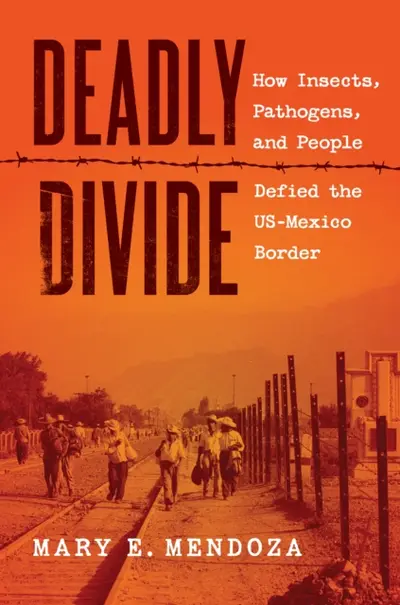
Deadly Divide
How Insects, Pathogens, and People Defied the US-Mexico Border
Price and availability
$202.99
Available in: Andorra, Austria, Australia, Belgium, Bulgaria, Canada, Switzerland, Cyprus, Czechia, Germany, Denmark, Estonia, Spain, Finland, France, United Kingdom, Guernsey, Greece, Croatia, Hungary, Ireland, Isle of Man, Iceland, Italy, Jersey, Japan, Liechtenstein, Lithuania, Luxembourg, Latvia, Monaco, Malta, Netherlands, Norway, Poland, Portugal, Romania, Sweden, Slovenia, Slovakia, San Marino, United States, Vatican City, South Africa
Stores: US, UK, Canada, EU, Australia.
Sign in to buyThe price is re-checked by the server before payment.
For personal use under the eBook licence.
- Format
- EPUB
- DRM
- Not stated by the publisher
- Language
- English
- Publisher
- The University of North Carolina Press
- Published
- 28 April 2026
- ISBN
- 9781469695426
- Subjects
- Western & Pacific Coast states, Mexico, History of the Americas, Historical geography, Migration, immigration & emigration, Local history, US West, Migration, immigration and emigration, History of the Americas, Historical geography, Local history
About this book
When most people picture the US-Mexico border, they think of walls, fences, concrete, and wire. But in this first history of how the environment influenced physical boundary-making between the two nations, Mary E. Mendoza focuses on how the natural world shaped ideas about race, gender, and security. In so doing, she unearths surprising origins of the modern-day immigration debate.Mexican migrants have historically been seen by some in the US as invasive and less than human. But actual invasive pests are part of this story. Deadly Divide shows how cattle ticks, the body louse, foot-and-mouth disease, and the female Mexican fruit fly contributed to the to the ever-increasing racialization of Mexican migrants, which in turn led to increased policing, criminalization, and fears about immigrants infiltrating the US. As Mendoza follows the stories of migrants in relation to various species, Indigenous peoples, and officials on both sides of the border, she argues that the need for mobility overpowered both governments laws, fences, and agents. At the same time, the borders symbolic power became a source of terror not only for migrants who try to cross into the US but for those who feel they cannot cross back, making the US a nation that suspends immigrants between two worlds.
Bibliographic data © Gardners Books Ltd.