EPUB · English
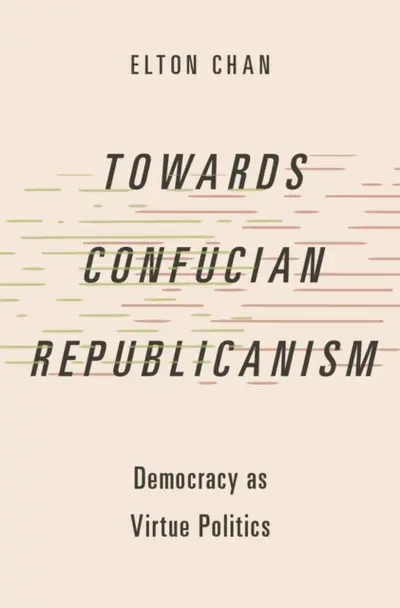
Towards Confucian Republicanism
Democracy as Virtue Politics
Price and availability
$97.99
Available in: Andorra, Austria, Australia, Belgium, Bulgaria, Canada, Switzerland, Cyprus, Czechia, Germany, Denmark, Estonia, Spain, Finland, France, United Kingdom, Guernsey, Greece, Croatia, Hungary, Ireland, Isle of Man, Iceland, Italy, Jersey, Japan, Liechtenstein, Lithuania, Luxembourg, Latvia, Monaco, Malta, Netherlands, Norway, Poland, Portugal, Romania, Sweden, Slovenia, Slovakia, San Marino, United States, Vatican City, South Africa
Stores: US, UK, Canada, EU, Australia.
Sign in to buyThe price is re-checked by the server before payment.
For personal use under the eBook licence.
- Format
- EPUB
- DRM
- Not stated by the publisher
- Language
- English
- Publisher
- Oxford University Press
- Published
- 31 January 2025
- ISBN
- 9780197695869
- Subjects
- Social & political philosophy, Political science & theory, Geopolitics, Political science and theory, Geopolitics, QDTS
About this book
Over the last century, Confucianism has been searching for a place in the modern political world. This ancient tradition was once the philosophical cornerstone upon which powerful political orders were built, but the collapse of monarchies in the twentieth century has removed Confucianism from its institutional manifestations. And despite the liberal turn of Confucianism in the 1950s that sought to adopt liberal democracy as the tradition's political future, there appears to be an increasing revival of the authoritarian strands of thought among Confucian scholarship. In Towards Confucian Republicanism, Elton Chan develops a theoretical framework of Confucianism for the twenty-first century. Chan argues that liberal Confucians must take seriously the internal authoritarian leanings of Confucianism--and then argue against such strands of the Confucian tradition. He shows that Confucians are keen on concentrating power in the hands of the virtuous not merely for promoting order and material livelihood, but also for general moral cultivation. Yet this use of political and moral hierarchy as institutional platforms for perfectionist development is self-defeating. To counter the authoritarian turn in Confucian scholarship, Chan articulates a vision of a hybrid political order that brings together Confucianism and republican democracy. He makes the case that Confucianism stands a much higher chance of achieving its political and moral ideals--good governance and collective virtuous cultivation--when merged with republicanism. Covering a uniquely wide range of Confucian classics and outlining his novel vision for Confucianism, Chan addresses pressing issues in contemporary political philosophy, including virtue politics, balance of power, civic education, public reason constraint, and the role of civil society. In so doing, Chan convincingly argues that to materialize Confucianism's ideals is to collectively practice democracy as a virtuous way of life.
Bibliographic data © Gardners Books Ltd.