PDF · English
Carnalities
The Art of Living in Latinidad
Price and availability
$47.99
Available in: Andorra, Austria, Australia, Belgium, Bulgaria, Canada, Switzerland, Cyprus, Czechia, Germany, Denmark, Estonia, Spain, Finland, France, United Kingdom, Guernsey, Greece, Croatia, Hungary, Ireland, Isle of Man, Iceland, Italy, Jersey, Japan, Liechtenstein, Lithuania, Luxembourg, Latvia, Monaco, Malta, Netherlands, Norway, Poland, Portugal, Romania, Sweden, Slovenia, Slovakia, San Marino, United States, Vatican City, South Africa
Stores: US, UK, Canada, EU, Australia.
Sign in to buyThe price is re-checked by the server before payment.
For personal use under the eBook licence.
- Format
- DRM
- Not stated by the publisher
- Language
- English
- Publisher
- Duke University Press
- Published
- 8 November 2024
- ISBN
- 9781478060246
- Subjects
- USA, Photography & photographs, Social & cultural history, Philosophy: aesthetics, Ethnic studies, Hispanic & Latino studies, United States of America, USA, Photography and photographs, JBSL, NHTB, QDTN
About this book
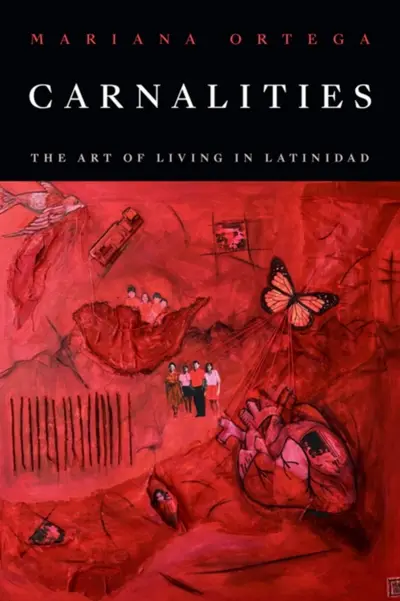
In Carnalities, Mariana Ortega presents a phenomenological study of aesthetics grounded in the work of primarily Latinx artists. She introduces the idea of carnal aesthetics informed by carnalities, creative practices shaped by the self's affective attunement to the material, cultural, historical, communal, and spiritual. For Ortega, carnal aesthetics offers a way to think about the affective and bodily experiences of racialized selves. Drawing on Gloria Anzaldua, Chela Sandoval, Jose Esteban Munoz, Alia Al-Saji, Helen Ngo, Maurice Merleau-Ponty, Roland Barthes, and others, Ortega examines photographic works on Latinx subjects. She analyzes the photography of Laura Aguilar, Veronica Gabriela Cardenas, and Susan Meiselas, among others, theorizing photography as a carnal, affective medium that is crucial for processes of self-formation, resistance, and mourning in Latinx life. She ends with an intimate reading of photography through a reflection of her own crossing from Nicaragua to the United States in 1979. Motivated by her experience of loss and exile, Ortega argues for the importance of carnal aesthetics in destabilizing and transforming normative, colonial, and decolonial subjects, imaginaries, and structures.
Bibliographic data © Gardners Books Ltd.