EPUB · English
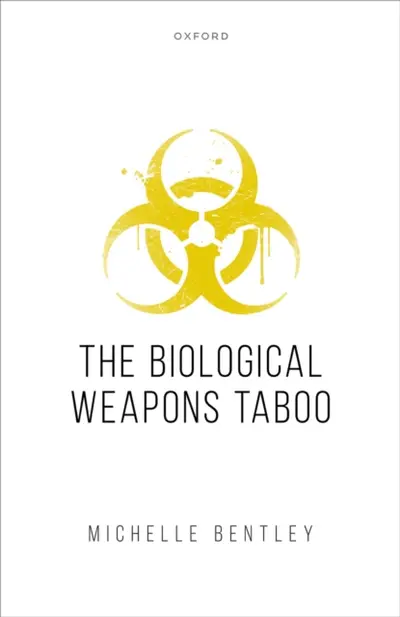
Biological Weapons Taboo
Price and availability
$87.99
Available in: Andorra, Austria, Australia, Belgium, Bulgaria, Canada, Switzerland, Cyprus, Czechia, Germany, Denmark, Estonia, Spain, Finland, France, United Kingdom, Guernsey, Greece, Croatia, Hungary, Ireland, Isle of Man, Iceland, Italy, Jersey, Japan, Liechtenstein, Lithuania, Luxembourg, Latvia, Monaco, Malta, Netherlands, Norway, Poland, Portugal, Romania, Sweden, Slovenia, Slovakia, San Marino, United States, Vatican City, South Africa
Stores: US, UK, Canada, EU, Australia.
Sign in to buyThe price is re-checked by the server before payment.
For personal use under the eBook licence.
- Format
- EPUB
- DRM
- Not stated by the publisher
- Language
- English
- Publisher
- Oxford University Press
- Published
- 19 September 2023
- ISBN
- 9780198892175
- Subjects
- International relations, Defence strategy, planning & research, International relations, Military and defence strategy
About this book
The non-use of biological weapons has been described as the 'great mystery of biological warfare.' The Biological Weapons Taboo solves that mystery by analysing the bioweapons taboo, in the first comprehensive study of the concept. Bentley explains precisely why bioweapons are perceived as repulsive and how this sentiment is consequently expressed in the form of political behaviours, including the refusal to engage in biological aggression. Drawing on extensive archival evidence, this volume looks back on United States' foreign policy decision-making (particularly in relation to the Geneva Protocol and the Biological Weapons Convention) to demonstrate how and why the taboo has comprised a decisive factor in shaping both biowarfare strategy and political rhetoric - and why the taboo needs to be recognised as a necessary consideration in the study of bioweapons. In analysing a taboo, the volume also takes the debate on international norms forward by questioning and challenging the wider analytic comprehension of 'taboo' itself. Rejecting current definitions of the concept as inadequate, Bentley proposes a new and original model of understanding based on the normative characteristics of disgust, stigmatization, and fetishization.
Bibliographic data © Gardners Books Ltd.