PDF · English
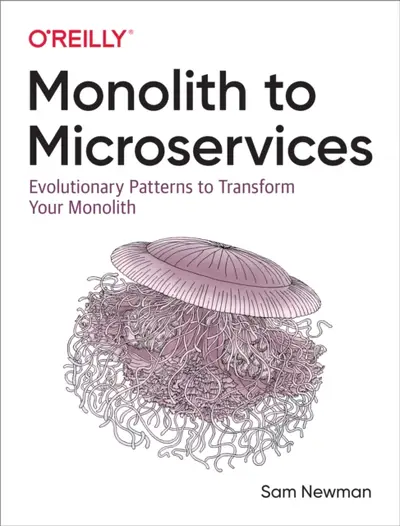
Monolith to Microservices
Evolutionary Patterns to Transform Your Monolith
Price and availability
$46.99
Available in: Andorra, Austria, Australia, Belgium, Bulgaria, Canada, Switzerland, Cyprus, Czechia, Germany, Denmark, Estonia, Spain, Finland, France, United Kingdom, Guernsey, Greece, Croatia, Hungary, Ireland, Isle of Man, Iceland, Italy, Jersey, Japan, Liechtenstein, Lithuania, Luxembourg, Latvia, Monaco, Malta, Netherlands, Norway, Poland, Portugal, Romania, Sweden, Slovenia, Slovakia, San Marino, United States, Vatican City, South Africa
Stores: US, UK, Canada, EU, Australia.
Sign in to buyThe price is re-checked by the server before payment.
For personal use under the eBook licence.
- Format
- DRM
- Not stated by the publisher
- Language
- English
- Publisher
- O'Reilly Media
- Published
- 14 November 2019
- ISBN
- 9781492047810
- Subjects
- Web programming, Software Engineering, Systems analysis & design, Computer architecture & logic design, Parallel processing, Web programming, Software Engineering, Systems analysis and design, Computer architecture and logic design, Parallel processing
About this book
How do you detangle a monolithic system and migrate it to a microservice architecture? How do you do it while maintaining business-as-usual? As a companion to Sam Newmans extremely popular Building Microservices, this new book details a proven method for transitioning an existing monolithic system to a microservice architecture.With many illustrative examples, insightful migration patterns, and a bevy of practical advice to transition your monolith enterprise into a microservice operation, this practical guide covers multiple scenarios and strategies for a successful migration, from initial planning all the way through application and database decomposition. Youll learn several tried and tested patterns and techniques that you can use as you migrate your existing architecture.Ideal for organizations looking to transition to microservices, rather than rebuildHelps companies determine whether to migrate, when to migrate, and where to beginAddresses communication, integration, and the migration of legacy systemsDiscusses multiple migration patterns and where they applyProvides database migration examples, along with synchronization strategiesExplores application decomposition, including several architectural refactoring patternsDelves into details of database decomposition, including the impact of breaking referential and transactional integrity, new failure modes, and more
Bibliographic data © Gardners Books Ltd.