PDF · English
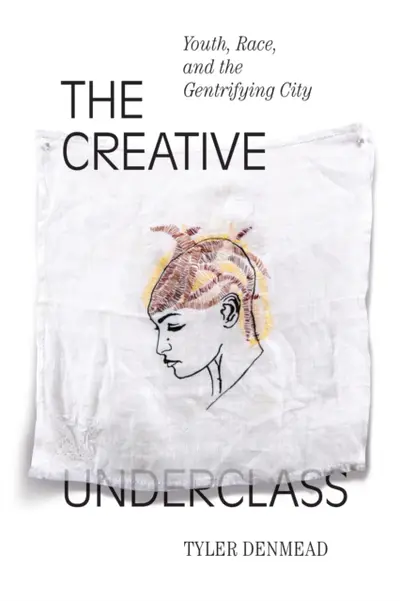
Creative Underclass
Youth, Race, and the Gentrifying City
Price and availability
$35.99
Available in: Andorra, Austria, Australia, Belgium, Bulgaria, Canada, Switzerland, Cyprus, Czechia, Germany, Denmark, Estonia, Spain, Finland, France, United Kingdom, Guernsey, Greece, Croatia, Hungary, Ireland, Isle of Man, Iceland, Italy, Jersey, Japan, Liechtenstein, Lithuania, Luxembourg, Latvia, Monaco, Malta, Netherlands, Norway, Poland, Portugal, Romania, Sweden, Slovenia, Slovakia, San Marino, United States, Vatican City, South Africa
Stores: US, UK, Canada, EU, Australia.
Sign in to buyThe price is re-checked by the server before payment.
For personal use under the eBook licence.
- Format
- DRM
- Not stated by the publisher
- Language
- English
- Publisher
- Duke University Press
- Published
- 8 November 2019
- Pages
- 216
- ISBN
- 9781478007319
- Subjects
- Rhode Island, Art: financial aspects, Cultural studies, Urban communities, Black & Asian studies, 1KBB-US-NER, Art: financial aspects, JBCC, JBSD, JBSL
About this book
As an undergraduate at Brown University, Tyler Denmead founded New Urban Arts, a nationally recognized arts and humanities program primarily for young people of color in Providence, Rhode Island. Along with its positive impact, New Urban Arts, under his leadership, became entangled in Providence's urban renewal efforts that harmed the very youth it served. As in many deindustrialized cities, Providence's leaders viewed arts, culture, and creativity as a means to drive property development and attract young, educated, and affluent white people, such as Denmead, to economically and culturally kick-start the city. In The Creative Underclass, Denmead critically examines how New Urban Arts and similar organizations can become enmeshed in circumstances where young people, including himself, become visible once the city can leverage their creativity to benefit economic revitalization and gentrification. He points to the creative cultural practices that young people of color from low-income communities use to resist their subjectification as members of an underclass, which, along with redistributive economic policies, can be deployed as an effective means with which to both oppose gentrification and better serve the youth who have become emblematic of urban creativity.
Bibliographic data © Gardners Books Ltd.