PDF · English
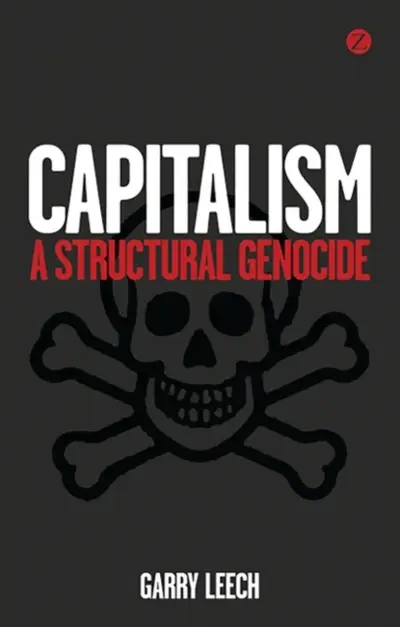
Capitalism
A Structural Genocide
Price and availability
$21.99
Available in: Andorra, Austria, Australia, Belgium, Bulgaria, Canada, Switzerland, Cyprus, Czechia, Germany, Denmark, Estonia, Spain, Finland, France, United Kingdom, Guernsey, Greece, Croatia, Hungary, Ireland, Isle of Man, Iceland, Italy, Jersey, Japan, Liechtenstein, Lithuania, Luxembourg, Latvia, Monaco, Malta, Netherlands, Norway, Poland, Portugal, Romania, Sweden, Slovenia, Slovakia, San Marino, United States, Vatican City, South Africa
Stores: US, UK, Canada, EU, Australia.
Sign in to buyThe price is re-checked by the server before payment.
For personal use under the eBook licence.
- Format
- DRM
- Not stated by the publisher
- Language
- English
- Publisher
- Bloomsbury Publishing
- Published
- 26 April 2012
- Pages
- 194
- ISBN
- 9781780322018
- Subjects
- Developing countries, Political ideologies, International relations, Economic theory & philosophy, Economics of industrial organisation, Development economics & emerging economies, Global South / Developing countries, Political ideologies and movements, International relations, Economic theory and philosophy, Economics of industrial organization, Development economics and emerging economies
About this book
In the wake of the global financial crisis, and ongoing savage government cuts across the world, Garry Leech addresses a pressing and necessary topic: the nature of contemporary capitalism, and how it inherently generates inequality and structural violence.Drawing on a number of fascinating case studies from across the world - including the forced displacement of farmers in Mexico, farmer suicides in India, and deaths from preventable and treatable diseases in Sub-Saharan Africa, as well as the unsustainable exploitation of the planet's natural resources - Leech provocatively argues that global capitalism constitutes a form of genocide against the poor, particularly in the global South.Essential and eye-opening the book questions the legitimacy of a system that inevitably results in such large-scale human suffering, while going beyond mere critique to offer a more egalitarian, democratic and sustainable global alternative.
Bibliographic data © Gardners Books Ltd.