PDF · English
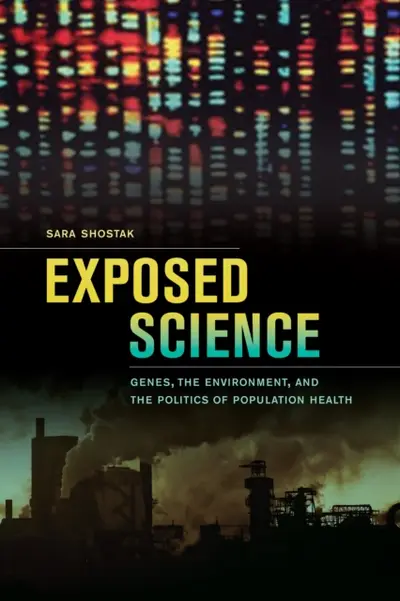
Exposed Science
Genes, the Environment, and the Politics of Population Health
Price and availability
$33.99
Available in: Andorra, Austria, Australia, Belgium, Bulgaria, Canada, Switzerland, Cyprus, Czechia, Germany, Denmark, Estonia, Spain, Finland, France, United Kingdom, Guernsey, Greece, Croatia, Hungary, Ireland, Isle of Man, Iceland, Italy, Jersey, Japan, Liechtenstein, Lithuania, Luxembourg, Latvia, Monaco, Malta, Netherlands, Norway, Poland, Portugal, Romania, Sweden, Slovenia, Slovakia, San Marino, United States, Vatican City, South Africa
Stores: US, UK, Canada, EU, Australia.
Sign in to buyThe price is re-checked by the server before payment.
For personal use under the eBook licence.
- Format
- DRM
- Not stated by the publisher
- Language
- English
- Publisher
- University of California Press
- Published
- 15 February 2013
- ISBN
- 9780520955240
- Subjects
- Public health & preventive medicine, History of medicine, Popular medicine & health, Health systems and services, Medicolegal issues, History of medicine, Popular medicine and health
About this book
We rely on environmental health scientists to document the presence of chemicals where we live, work, and play and to provide an empirical basis for public policy. In the last decades of the 20th century, environmental health scientists began to shift their focus deep within the human body, and to the molecular level, in order to investigate gene-environment interactions. In Exposed Science, Sara Shostak analyzes the rise of gene-environment interaction in the environmental health sciences and examines its consequences for how we understand and seek to protect population health. Drawing on in-depth interviews and ethnographic observation, Shostak demonstrates that what we know - and what we don't know - about the vulnerabilities of our bodies to environmental hazards is profoundly shaped by environmental health scientists' efforts to address the structural vulnerabilities of their field. She then takes up the political effects of this research, both from the perspective of those who seek to establish genomic technologies as a new basis for environmental regulation, and from the perspective of environmental justice activists, who are concerned that that their efforts to redress the social, political, and economical inequalities that put people at risk of environmental exposure will be undermined by molecular explanations of environmental health and illness. Exposed Science thus offers critically important new ways of understanding and engaging with the emergence of gene-environment interaction as a focal concern of environmental health science, policy-making, and activism.
Bibliographic data © Gardners Books Ltd.