PDF · English
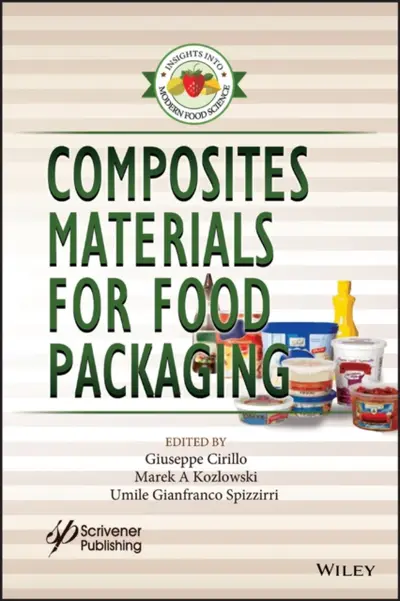
Composites Materials for Food Packaging
Price and availability
$259.99
Available in: Andorra, Austria, Australia, Belgium, Bulgaria, Canada, Switzerland, Cyprus, Czechia, Germany, Denmark, Estonia, Spain, Finland, France, United Kingdom, Guernsey, Greece, Croatia, Hungary, Ireland, Isle of Man, Iceland, Italy, Jersey, Japan, Liechtenstein, Lithuania, Luxembourg, Latvia, Monaco, Malta, Netherlands, Norway, Poland, Portugal, Romania, Sweden, Slovenia, Slovakia, San Marino, United States, Vatican City, South Africa
Stores: US, UK, Canada, EU, Australia.
Sign in to buyThe price is re-checked by the server before payment.
For personal use under the eBook licence.
- Format
- DRM
- Not stated by the publisher
- Language
- English
- Publisher
- Wiley
- Published
- 4 May 2018
- ISBN
- 9781119160212
- Subjects
- Business & management, Food & beverage technology, Business and Management, Food and beverage technology
About this book
The novel insights, as well as the main drawbacks of each engineered composites material is extensively evaluated taking into account the strong relationship between packaging materials, environmental and reusability concerns, food quality, and nutritional value. Composites, by matching the properties of different components, allow the development of innovative and performing strategies for intelligent food packaging, thus overcoming the limitations of using only a single material. The book starts with the description of montmorillonite and halloysite composites, subsequently moving to metal-based materials with special emphasis on silver, zinc, silicium and iron. After the discussion about how the biological influences of such materials can affect the performance of packaging, the investigation of superior properties of sp2 carbon nanostructures is reported. Here, carbon nanotubes and graphene are described as starting points for the preparation of highly engineered composites able to promote the enhancement of shelf-life by virtue of their mechanical and electrical features. Finally, in the effort to find innovative composites, the applicability of biodegradable materials from both natural (e.g. cellulose) and synthetic (e.g. polylactic acid PLA) origins, with the aim to prove that polymer-based materials can overcome some key limitations such as environmental impact and waste disposal.
Bibliographic data © Gardners Books Ltd.