PDF · English
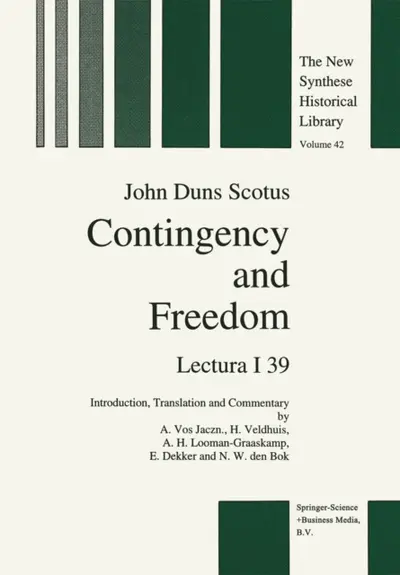
Contingency and Freedom
Lectura I 39
Price and availability
$120.99
Available in: Andorra, Austria, Australia, Belgium, Bulgaria, Canada, Switzerland, Cyprus, Czechia, Germany, Denmark, Estonia, Spain, Finland, France, United Kingdom, Guernsey, Greece, Croatia, Hungary, Ireland, Isle of Man, Iceland, Italy, Jersey, Japan, Liechtenstein, Lithuania, Luxembourg, Latvia, Monaco, Malta, Netherlands, Norway, Poland, Portugal, Romania, Sweden, Slovenia, Slovakia, San Marino, United States, Vatican City, South Africa
Stores: US, UK, Canada, EU, Australia.
Sign in to buyThe price is re-checked by the server before payment.
For personal use under the eBook licence.
- Format
- DRM
- Not stated by the publisher
- Language
- English
- Publisher
- Springer Netherlands
- Published
- 17 April 2013
- ISBN
- 9789401582759
- Subjects
- Western philosophy: Medieval & Renaissance, c 500 to c 1600, Philosophy: metaphysics & ontology, Religion: general, Philosophy of religion, Medieval Western philosophy, Philosophy: metaphysics and ontology, Religion: general, Philosophy of religion
About this book
During the seventies, there was a revival of systematic philosophy in general and of ontology in particular. At the same time, especially in Anglo-Saxon thinking, systematic philosophy interacted very creatively with the history of medieval philosophy. It seems to us that the work of John Duns Scotus (1266-1308) could substantially benefit these develop- ments. Not only this, but his works cries out to be developed across the whole spectrum of theology -that science which, in the Middle Ages, ruled all others ('regina scientiarum'). This book is the outcome of several years of scholarship and friend- ship during which, guided by Dr. A. Vos, we have studied the work of Scotus. Our research group is connected to the Theological Faculty of Utrecht and to the Dutch Franciscan Study Centre (Stichting Francis- caans Studiecentrum). This study presents a translation and commentary of Lectura I 39, which, in our view, is noteable as one of the key texts in the history of systematic theology and philosophy. In this book we have used specialist language and argumentation, but at the same time have taken pains to make it useful to a circle of in- terested readers wider than simply that of those well-versed in medieval scholasticism. In this way, we hope to present the difficult but instruc- tive work of the 'subtle master' ('doctor subtilis') in such a way as to make it attractive to other scholars and students in theology and philoso- phy.
Bibliographic data © Gardners Books Ltd.