EPUB · English
Imposing Preacher
Samuel DeWitt Proctor and Black Public Faith
Price and availability
$29.99
Available in: Andorra, Austria, Australia, Belgium, Bulgaria, Canada, Switzerland, Cyprus, Czechia, Germany, Denmark, Estonia, Spain, Finland, France, United Kingdom, Guernsey, Greece, Croatia, Hungary, Ireland, Isle of Man, Iceland, Italy, Jersey, Japan, Liechtenstein, Lithuania, Luxembourg, Latvia, Monaco, Malta, Netherlands, Norway, Poland, Portugal, Romania, Sweden, Slovenia, Slovakia, San Marino, United States, Vatican City, South Africa
Stores: US, UK, Canada, EU, Australia.
Sign in to buyThe price is re-checked by the server before payment.
For personal use under the eBook licence.
- Format
- EPUB
- DRM
- Not stated by the publisher
- Language
- English
- Publisher
- Augsburg Fortress Publishers
- Published
- 1 June 2013
- Pages
- 264
- ISBN
- 9781451452242
- Subjects
- Church history, History of religion, Christianity, Christian Churches, denominations, groups, Christian life and practice, Religious social and pastoral thought and activity
About this book
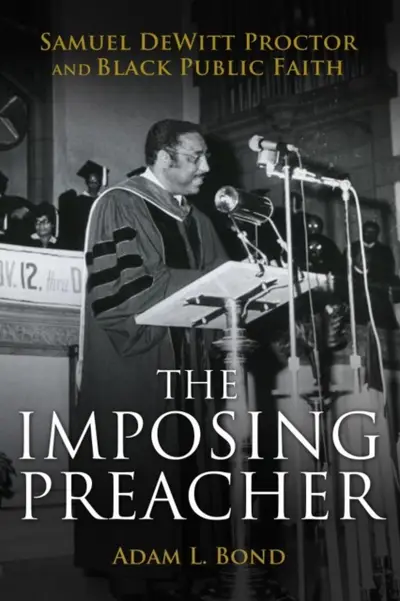
As a distinguished Baptist pastor, educator, and public servant, Samuel DeWitt Proctor made it his mission to serve American life by fighting against racism. In The Imposing Preacher, Adam Bond shows how Proctor, as the product of a prophetic black church tradition, a social gospel-laced liberal Protestantism, and a black middle-class integrationist ethos, envisioned a type of pulpit activism through which the United States could realize a civil society and genuine community, and was able to anticipate and contest some of the themes articulated in the black religious movements of the late twentieth century.Bond shows Proctor to be a public theologian committed to developing an inclusive and racially pluralistic global society that confronts racism as the social crisis of its time. Proctor did not respond to segregation through marches and visible protests. Instead he saw the classroom and the pulpit as the sacred spaces for dialogue about race in America. In this way, he presents an alternative model of religious and social leadership and for studies of African American religion in the twentieth century.
Bibliographic data © Gardners Books Ltd.