PDF · English
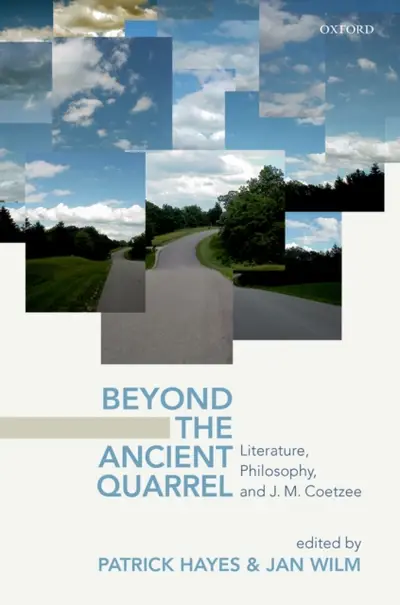
Beyond the Ancient Quarrel
Literature, Philosophy, and J.M. Coetzee
Price and availability
$85.99
Available in: Andorra, Austria, Australia, Belgium, Bulgaria, Canada, Switzerland, Cyprus, Czechia, Germany, Denmark, Estonia, Spain, Finland, France, United Kingdom, Guernsey, Greece, Croatia, Hungary, Ireland, Isle of Man, Iceland, Italy, Jersey, Japan, Liechtenstein, Lithuania, Luxembourg, Latvia, Monaco, Malta, Netherlands, Norway, Poland, Portugal, Romania, Sweden, Slovenia, Slovakia, San Marino, United States, Vatican City, South Africa
Stores: US, UK, Canada, EU, Australia.
Sign in to buyThe price is re-checked by the server before payment.
For personal use under the eBook licence.
- Format
- DRM
- Not stated by the publisher
- Language
- English
- Publisher
- Oxford University Press
- Published
- 8 December 2017
- ISBN
- 9780192527677
- Subjects
- Literary theory, Literary studies: fiction, novelists & prose writers, Philosophy, Western philosophy: Ancient, to c 500, Literary theory, Literary studies: fiction, novelists and prose writers, Philosophy
About this book
In Plato's Republic, Socrates spoke of an 'ancient quarrel between literature and philosophy' which he offered to resolve once and for all by banning the poets from his ideal city. Few philosophers have taken Socrates at his word, and out of the ancient quarrel there has emerged a long tradition that has sought to value literature chiefly as a useful supplement to philosophical reasoning. The fiction of J.M. Coetzee makes a striking challenge to this tradition. While his writing has frequently engaged philosophical subjects in explicit ways, it has done so with an emphasis on the dissonance between literary expression and philosophical reasoning. And while Coetzee has often overtly engaged with academic literary theory, his fiction has done so in a way that has tended to disorient rather than affirm those same theories, wrong-footing the normal processes of literary interpretation. This volume brings together philosophers and literary theorists to reflect upon the challenge Coetzee has made to their respective disciplines, and to the disciplinary distinctions at stake in the ancient quarrel. The essays use his fiction to explore questions about the boundaries between literature, philosophy, and literary criticism; the relationship between literature, theology, and post-secularism; the particular ways in which literature engages reality; how literature interacts with the philosophies of language, action, subjectivity, and ethics; and the institutions that govern the distinctions between literature and philosophy. It will be of importance not only to readers of Coetzee, but to anyone interested in the ancient quarrel itself.
Bibliographic data © Gardners Books Ltd.