PDF · English
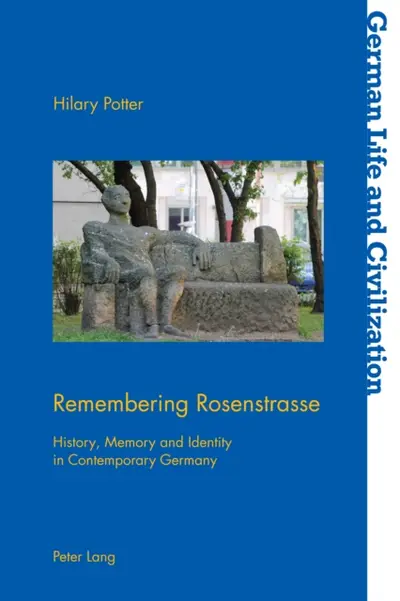
Remembering Rosenstrasse
History, Memory and Identity in Contemporary Germany
Price and availability
$73.99
Available in: Andorra, Austria, Australia, Belgium, Bulgaria, Canada, Switzerland, Cyprus, Czechia, Germany, Denmark, Estonia, Spain, Finland, France, United Kingdom, Guernsey, Greece, Croatia, Hungary, Ireland, Isle of Man, Iceland, Italy, Jersey, Japan, Liechtenstein, Lithuania, Luxembourg, Latvia, Monaco, Malta, Netherlands, Norway, Poland, Portugal, Romania, Sweden, Slovenia, Slovakia, San Marino, United States, Vatican City, South Africa
Stores: US, UK, Canada, EU, Australia.
Sign in to buyThe price is re-checked by the server before payment.
For personal use under the eBook licence.
- Format
- DRM
- Not stated by the publisher
- Language
- English
- Publisher
- Peter Lang Ltd, International Academic Publishers
- Published
- 12 November 2018
- ISBN
- 9781787071421
- Subjects
- Germany, Film theory & criticism, Literary studies: fiction, novelists & prose writers, History, Germany, Film history, theory or criticism, Literary studies: fiction, novelists and prose writers, History
About this book
In February 1943 intermarried Germans gathered in Berlin's Rosenstrasse to protest the feared deportation of their Jewish spouses. This book examines the competing representations of the Rosenstrasse protest in contemporary Germany, demonstrating how cultural memories of this event are intertwined with each other and with concepts of identity. It analyses these shifting patterns of memory and what they reveal about the dynamics of the past-present relationship from the earliest post-unification period up to the present day. Interdisciplinary in its approach, the book provides insights into the historical debate surrounding the protest, accounts in popular history and biography, an analysis of von Trotta's 2003 film Rosenstrae, and an exploration of the multiple memorials to this historical event.The study reveals that the protest s remembrance is fraught with competing desires: to have a less encumbered engagement with this past and to retain a critical memory of the events that allows for a recognition of both heroism and accountability. It concludes that we are on the cusp of witnessing a new shift in remembering that reflects contemporary socio-political tensions with the resurgence of the far right, noting how this is already becoming visible in existing representations of the Rosenstrasse protest.
Bibliographic data © Gardners Books Ltd.